

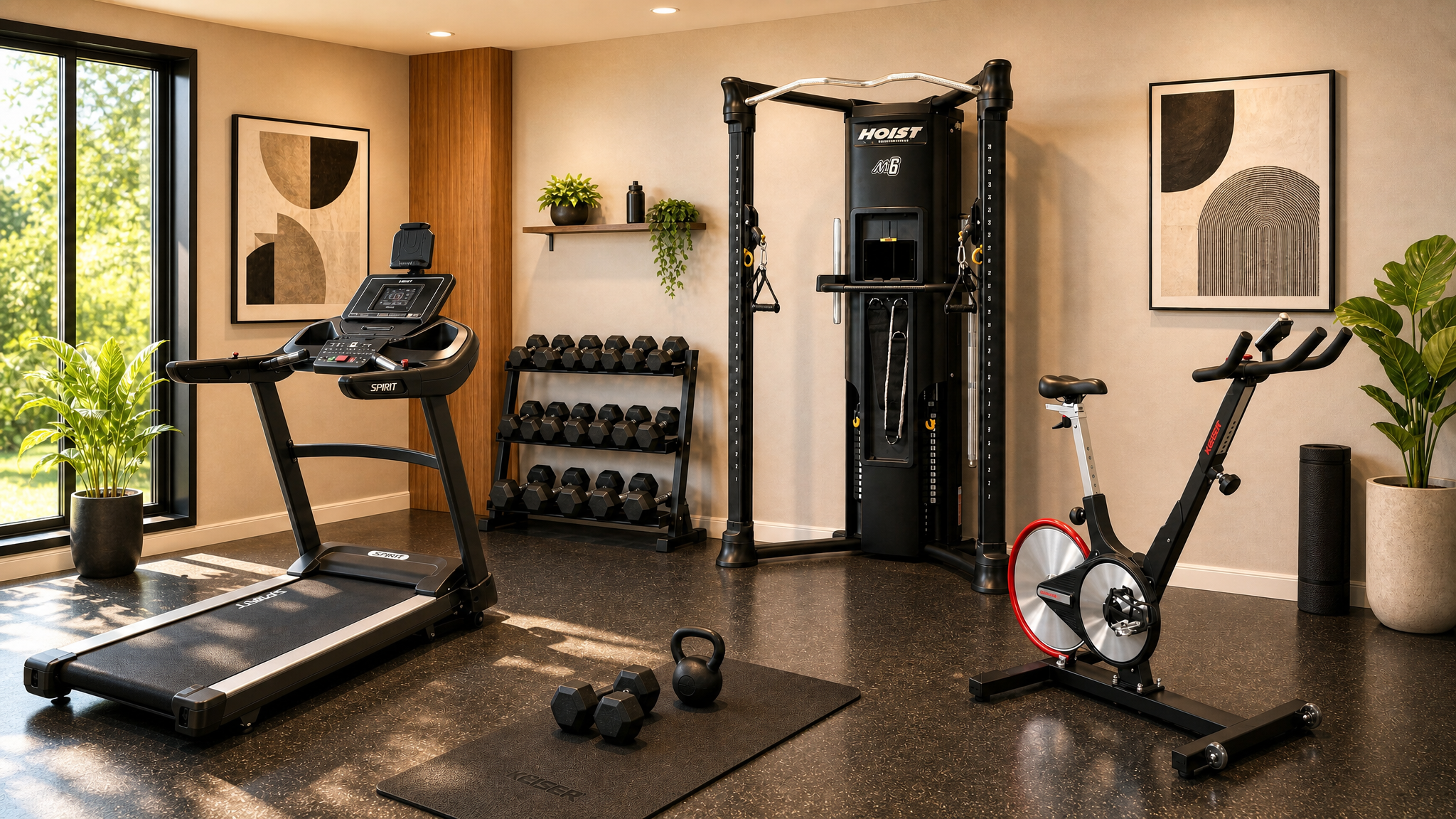
Summer is one of the best times of year to invest in a home gym. Motivation is high, schedules open up, and the idea of skipping a crowded commercial gym in favor of training on your own terms becomes even more appealing. Whether you are building from scratch or filling in the gaps in an existing setup, the decisions you make now will shape how you train for years to come.
This guide is designed to cut through the noise. No filler, no gimmicks. Just a clear framework for assessing your space, setting a budget, choosing equipment that actually matches your goals, and avoiding the mistakes that leave gear sitting unused.
Start With Your Space
Before you look at a single product, measure your room. The dimensions of your space will determine almost every equipment decision that follows, and buying without accounting for footprint is one of the most common and costly mistakes home gym buyers make. Here is a quick breakdown of what different room sizes realistically support:
- 80–100 square feet (spare bedroom, apartment room): One focused cardio machine such as a folding treadmill or exercise bike, paired with adjustable dumbbells and a bench.
- 100–150 square feet (single-car garage, basement corner): A full-size cardio machine alongside a functional trainer or multi-station gym.
- 150+ square feet (two-car garage, dedicated gym room): A complete setup across multiple cardio and strength categories without compromise.
Ceiling height is the detail most buyers overlook. The majority of treadmills, ellipticals, and strength machines require at least seven to eight feet of clearance. Smith machines, cable systems with overhead attachments, and certain rack configurations need eight feet or more. Measure before you commit.
If you are setting up in a garage or unfinished basement, invest in rubber flooring before anything else. It protects your equipment, absorbs vibration, dampens noise, and makes the space feel intentional rather than improvised. It is the lowest-cost upgrade that makes the biggest visible difference.
Set a Realistic Budget
Home gym setups span a wide range of price points, and the right budget depends entirely on your goals, your space, and how seriously you train.
In the five hundred to fifteen hundred dollar range, you can build a strong starter setup around one quality cardio machine and a set of adjustable dumbbells. This is the right tier for beginners, apartment dwellers, or anyone who wants to get started without overcommitting.
From fifteen hundred to thirty-five hundred dollars, the options expand significantly. This budget supports a premium treadmill or elliptical alongside a functional trainer or bench and weight setup, giving you the ability to cover both cardio and strength training without cutting corners on either.
Above thirty-five hundred dollars, you are in commercial-grade territory. Equipment at this level is built for daily heavy use, carries longer warranties, and is designed to perform reliably for ten to twenty years with proper maintenance. For serious athletes or households where multiple people will be training regularly, the investment pays for itself over time.
One principle worth holding onto regardless of budget: one great piece of equipment is always a better investment than three mediocre ones. Buy the best version of what you actually need before expanding.
Match Your Equipment to Your Goals
The most common home gym mistake is buying equipment based on what looks impressive rather than what supports the way you actually train. The right setup looks different depending on what you are trying to accomplish.
If your primary goal is cardiovascular fitness or weight management, a quality treadmill, elliptical, or exercise bike is the right anchor piece. Treadmills are the most versatile option and work for everyone from walkers to serious runners. Ellipticals deliver comparable calorie burn with significantly less joint stress, making them the smarter choice for anyone with knee or hip concerns. Exercise bikes are the quietest of the three and the most apartment-friendly, particularly in magnetic resistance configurations.
A rowing machine is worth serious consideration as a complement to any of the above. It is one of the most effective full-body cardio options available, engages the majority of your muscle groups in every stroke, and is completely low-impact. It remains underutilized in most home gyms despite being one of the highest-return investments you can make.
For strength-focused training, a functional trainer is the single most versatile piece of equipment you can buy. The adjustable dual-cable system allows you to perform hundreds of different exercises from one machine, covering chest, back, shoulders, arms, and core without requiring a wall of individual stations. For home gyms working with limited square footage, the return on space is unmatched.
The most common and most future-proof approach is a balanced setup that covers both cardio and strength. A treadmill or elliptical paired with a functional trainer handles the majority of training goals for most people. As the setup matures, adding adjustable dumbbells, a bench, and eventually a multi-station gym fills in the remaining gaps without redundancy.
Treadmills
Treadmills remain the top-selling piece of home cardio equipment for good reason. They replicate natural movement, require no learning curve, and serve walkers, joggers, and serious runners equally well. When evaluating options, motor power, deck size, and incline range are the specifications that matter most in real-world use.
For home use, a motor rated at 3.0 horsepower or higher handles regular running without strain. Deck size should be at least 20 by 55 inches for a comfortable stride. An incline range of zero to ten percent covers most training needs, while zero to fifteen percent opens up more serious hill work.
A few models worth considering from our current lineup:
- Life Fitness F3 Folding Treadmill — Commercial-grade Life Fitness engineering in a space-saving folding design. A strong choice for buyers who want premium build quality without committing to a permanent footprint.
- Spirit Fitness XT685 Treadmill — A step up in motor power and console features, well suited for serious runners and multi-user households.
- Life Fitness T3 Treadmill — One of the most recognized names in fitness for a reason. The T3 delivers a commercial-quality ride in a home-focused package.
- True Fitness PS 3000 Treadmill — For buyers who want the smoothest possible ride and commercial-grade durability at home. One of the best-built machines in its category.
Browse the full treadmill collection to compare models across every price point.
Ellipticals
Ellipticals are consistently among the most used pieces of equipment in both home and commercial gym settings. The combination of full-body engagement, low joint impact, and accessible learning curve makes them one of the most versatile cardio options available.
Stride length is the specification most buyers underestimate. Eighteen to twenty inches suits most users comfortably. Taller users above five feet ten inches will want to look at twenty to twenty-two inch stride options to avoid a choppy, constrained feel. Flywheel weight is a reliable indicator of ride smoothness — eighteen pounds or heavier delivers a noticeably more fluid motion that matters significantly over a long workout.
A few models worth considering:
- Spirit Fitness XE395 Elliptical — A smooth, feature-rich elliptical with a long stride and quiet operation. A strong mid-range option for serious home users.
- Life Fitness E3 Elliptical — The same FlexStride technology found in commercial Life Fitness machines, in a refined home-focused package.
- True Fitness M50 Elliptical — Commercial-grade build quality from True Fitness. One of the most durable and smooth-riding ellipticals in its class.
See our full elliptical collection here.
Exercise Bikes
Bikes are the quietest and most compact cardio option, which makes them particularly well suited to apartments, shared spaces, or anyone training early in the morning or late at night. Upright bikes provide a more traditional cycling position. Recumbent bikes offer additional lower back support and suit users with lumbar concerns. Indoor cycling bikes deliver the most intense output and are the preferred choice for interval-style training.
A few standouts from our collection:
- Keiser M3i Indoor Bike — The benchmark for indoor cycling bikes. Magnetic resistance, Bluetooth connectivity, and build quality that holds up in commercial settings. A favourite among serious cyclists.
- Life Fitness C1 Upright Bike — A straightforward, well-built upright bike from one of the most trusted names in fitness. Great for everyday cardio use.
- Spirit Fitness XBR55 Recumbent Bike — Comfortable, stable, and packed with workout programs. An excellent option for users who want joint-friendly cardio with back support.
Browse the full exercise bike collection to find the right style for your training.
Rowing Machines

A rowing machine is one of the most impactful and most underrated additions to a home gym. It delivers a full-body workout that combines cardiovascular conditioning with real muscular engagement, activating around 85 percent of your muscles with every stroke. It is completely low-impact, pairs well with any other cardio equipment you already own, and remains one of the few pieces of equipment that serious fitness enthusiasts are unlikely to find in a typical hotel or apartment gym.
A few standouts from our lineup:
- WaterRower with S4 Monitor — Water resistance that closely mimics on-water rowing, with a beautifully crafted wooden frame. One of the most natural-feeling rowers available and a standout piece in any home gym.
- Life Fitness Row HX Rower — Smooth magnetic resistance, reliable performance tracking, and the Life Fitness build quality that holds up under consistent daily use.
- Spirit Fitness CRW800 Rower — A well-priced commercial-quality rower with an intuitive console and smooth glide. Excellent value at its price point.
Browse our full rowing machine collection to find the right model for your space and training style.
Functional Trainers
A functional trainer with dual adjustable cable columns is the most space-efficient strength investment available for a home gym. From a single machine, you can perform chest presses, rows, lat pulldowns, shoulder raises, core rotations, curls, tricep extensions, and dozens of accessory movements covering every major muscle group. For anyone following a structured strength program, this is the piece that makes it possible to train at home without compromise.
A few of our most popular options:
- Hoist Fitness Mi5 Functional Trainer — A compact, well-priced dual-cable machine that fits neatly into most home gym spaces. Smooth, reliable, and backed by Hoist's commercial-grade build quality.
- Hoist Fitness Mi6 Functional Training System — A step up in weight stack capacity and adjustability, ideal for more serious lifters or households with multiple users at different strength levels.
- BodyCraft HFT PRO Functional Trainer — Dual 150 lb stacks with a full accessory package included. One of the best value-to-performance options in this category.
- Life Fitness G7 Gym — For buyers who want a premium, all-in-one strength system. The G7 combines cable training with a multi-station setup in a refined, space-conscious design.
View the full functional trainer collection to compare models and weight stack options.
Adjustable Dumbbells and Benches
Adjustable dumbbells replace an entire rack of fixed weights in a fraction of the space and are a practical choice across every budget tier. PowerBlock is the brand we recommend most consistently for home gym use — fast weight changes, compact footprint, and commercial-grade durability that holds up over years of regular training. Two models worth considering:
- PowerBlock Pro 50 — Adjusts from 5 to 50 lbs and replaces 19 traditional dumbbell pairs. A great fit for most home gym users across a wide range of exercises and fitness levels.
- PowerBlock Pro 100 EXP — For serious lifters who need heavier resistance. Expandable up to 100 lbs per dumbbell, making it a long-term investment that grows with your training.
A quality adjustable bench unlocks a wide range of pressing and accessory movements and pairs well with dumbbells, cables, or a functional trainer. Two strong options:
- Hoist Fitness HF5165 7-Position F.I.D. Bench — Seven adjustable positions, solid construction, and a compact footprint. One of the most versatile benches available for home gym use.
- Body-Solid GFID31 Flat Incline Decline Bench — A durable, well-built adjustable bench at a price point that suits most home gym budgets. Flat, incline, and decline positions covered.
Multi-Station Home Gyms
For households where multiple people train, or for users who want comprehensive strength coverage from a single footprint, a multi-station selectorized gym is worth serious consideration. A quality system replaces fifteen to twenty individual machines and supports a full upper and lower body training program without the need for additional equipment. It is one of the most efficient ways to build a complete home gym in a single purchase.
What to Skip
Not everything marketed as home gym equipment is worth the floor space. Here are the purchases most likely to disappoint:
- Budget treadmills under $500. These are almost universally built to standards not designed for consistent daily use. They wear out quickly, require frequent service, and often cost more in repairs than a quality machine would have cost to begin with.
- Single-purpose gadgets. Ab rollers, balance boards, and similar items are better treated as supplements after the foundational pieces are in place, not as substitutes for them.
- Resistance bands as your only strength tool. Useful as an accessory, but not a replacement for a structured strength setup. If building muscle or following a program is the goal, invest in real equipment.
- Equipment that is too large for your space. A machine you have to work around rather than work with will eventually stop being used. If the footprint does not fit comfortably with clear space on all sides, choose a more compact option or phase it in later.
A Few Summer-Specific Considerations
Garages and basements heat up quickly in summer, particularly in warmer climates. Before your first workout, make sure the space has adequate airflow. A quality fan or portable air conditioning unit is a worthwhile addition to any summer gym setup, and it makes a meaningful difference in how long and how hard you can train.
If you are placing equipment on a concrete floor, rubber gym tiles should go down before anything else arrives. They protect the floor, protect the equipment, and make the space significantly more comfortable underfoot.
Layout planning is worth doing before you buy, not after. Tape out the footprint of your planned equipment on the floor and live with it for a day or two. It is the simplest way to catch sizing issues before a several-hundred-pound machine is sitting in your space with nowhere comfortable to go.
Visit The Fitness Outlet
The Fitness Outlet carries commercial-grade cardio and strength equipment across four showroom locations. Our team works with home gym buyers at every budget and fitness level, and every piece of equipment in our showrooms is available to try before you buy. We also offer professional delivery and setup across all locations. Stop by, tell us what you are building, and we will help you put together the right setup for your space, your goals, and your budget.
Visit us in Bellevue, Tacoma, Lynnwood, or Rancho Cordova — or browse our full home gym collection online.


Share:
How to Set Up a Hotel Fitness Room That Guests Actually Use in 2026
Thorne Supplements: Complete Guide to What We Carry and Why