


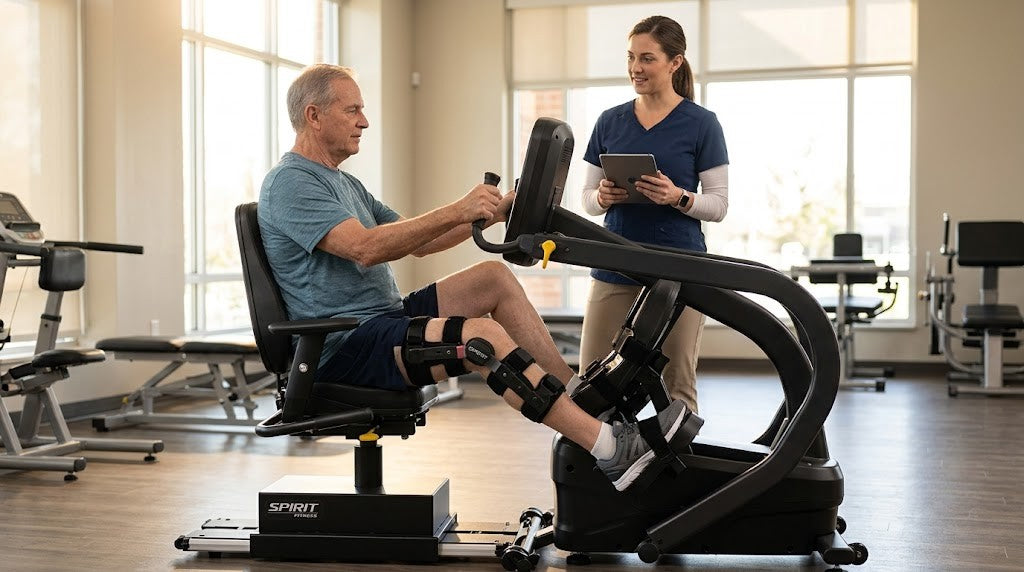
Physical therapy clinics have different equipment needs than a typical gym. Patients are recovering from surgery, injury, or chronic conditions, so every machine in the clinic has to do more than build fitness. It has to support controlled movement, protect joints, and adapt to a wide range of ability levels, sometimes within the same hour.
If you're opening a new clinic, expanding an existing one, or simply replacing equipment that isn't holding up to daily patient use, the right choices come down to a few core categories: recumbent bikes, seated ellipticals, vibration plates, and functional trainers. Here's what to look for in each, and why these categories matter so much for rehab settings specifically.

Why PT Clinics Need Different Equipment Than Gyms
A commercial gym is built around throughput and variety. A PT clinic is built around precision. Patients often need:
- Low-impact movement that doesn't stress a healing joint
- Adjustable resistance that can start extremely light and progress gradually
- Easy entry and exit for patients with limited mobility
- Equipment that a therapist can monitor and adjust in real time
This changes what "good equipment" means. A machine that's great for a general fitness member may be the wrong fit for someone six weeks post-surgery. That's why clinics tend to gravitate toward a specific, smaller set of equipment types rather than trying to stock everything a commercial gym would.
There's also a liability and oversight dimension that gyms don't usually have to think about. A therapist is often standing next to the patient, adjusting settings mid-session and watching for compensation patterns or signs of strain. That means the equipment itself needs controls that are easy to reach and adjust quickly, clear visual feedback on resistance or intensity, and a stable enough frame that a therapist can trust it during unpredictable movement. Equipment that's fussy to adjust or unclear to read slows down every single session, which adds up fast in a clinic seeing dozens of patients a day.
Recumbent Bikes: The Rehab Workhorse
Recumbent bikes are a staple in nearly every PT clinic, and for good reason. The seated, reclined position takes pressure off the lower back and reduces strain on the hips and knees compared to an upright bike. Patients recovering from knee replacements, hip surgery, or lower-body injuries can often start on a recumbent bike well before they're ready for other cardio equipment.
What to look for:
- Step-through frame design so patients with limited mobility can get on and off safely
- Fine-grained resistance adjustments, since rehab progress is often measured in very small increments
- Comfortable, supportive seating for patients who may be using the bike for extended sessions
- A simple, large console that's easy to read and doesn't require technical know-how
Brands like Life Fitness and Spirit Fitness make recumbent bikes with the smooth, quiet drivetrains and step-through access that PT settings need. If your clinic serves a lot of post-surgical or senior patients, this is usually the first machine to prioritize.
Browse our recumbent bike collection to compare models built for clinical use.
Seated Ellipticals: Bridging Cardio and Joint Protection
Seated ellipticals (sometimes called recumbent ellipticals) give clinics a middle ground between a recumbent bike and a standard upright elliptical. They allow for a more natural gait pattern and upper-body engagement while still keeping the patient seated and supported.
These machines work well for patients transitioning out of the earliest phase of rehab, once they've built some tolerance on a recumbent bike but aren't ready for full weight-bearing cardio. The seated position keeps balance concerns low, which matters for older patients or anyone with a fall risk.
Look for models with:
- Adjustable stride length to accommodate different body types
- Both arm and leg engagement options, so therapists can isolate upper or lower body work
- A stable, low center of gravity for safety
Explore our seated elliptical collection to see current models built for rehab and senior use.
Vibration Plates: Supporting Circulation and Bone Density
Vibration plates have earned a place in many PT clinics for their ability to support circulation, muscle activation, and bone density work, particularly for patients recovering from fractures or dealing with balance and mobility issues. Sessions tend to be short, so vibration plates fit well into a clinic's rotation without taking up much time per patient.
Power Plate is a widely used name in this category, and clinics often like these units because the intensity and frequency settings are precise enough for a therapist to fine-tune a protocol for an individual patient.
Vibration training isn't a replacement for strength or cardio work, but it's a useful complementary tool, especially for populations where traditional resistance training isn't appropriate yet.
Functional Trainers: Building Toward Real-World Movement
Once patients progress past the earliest phase of rehab, functional trainers become one of the most valuable tools in the clinic. Unlike fixed-plane machines, a functional trainer's cable system allows therapists to design movements that mimic real daily activities: reaching, pulling, rotating, and stabilizing.
This is especially useful for:
- Shoulder and rotator cuff rehab
- Post-surgical strengthening where range of motion needs to be controlled
- Sport-specific return-to-play programs
- General functional strength work for older adults
Look for a functional trainer with:
- Adjustable pulley heights that cover a wide range of exercises
- Light starting weight increments, since rehab loads are often much lower than typical gym loads
- A sturdy, stable frame that won't shift during asymmetric movements
Hoist, Keiser, and Life Fitness all make functional trainers that clinics rely on, with smooth cable resistance and small enough weight increments to suit a rehab population. Keiser's pneumatic resistance in particular is popular in clinical settings because it allows for very light, very precise resistance that's hard to replicate with traditional weight stacks.
Explore our functional trainer collection to find a model that fits your space and patient population.
Durability and Maintenance: What to Expect From Clinic-Grade Equipment
PT clinics put more cumulative wear on equipment than most home gyms will see in a decade. A single recumbent bike or functional trainer might be used by a dozen or more patients a day, often for months or years without a break in the schedule. That level of use changes what "durable" needs to mean.
A few things are worth asking any vendor before you buy:
- What's the frame warranty, and does it distinguish between light commercial and heavy clinical use? Some warranties are written around gym membership traffic, not the near-constant use a busy clinic sees.
- How accessible are the wear parts? Cables, pedals, and upholstery on high-use machines will eventually need replacing. Equipment that's easy for a technician to service means less downtime.
- Is there a service network near your clinic? A machine that's down for weeks waiting on a technician can disrupt treatment plans for multiple patients.
Clinics that plan for maintenance up front, rather than treating it as an afterthought, tend to get significantly more useful life out of their equipment investment.
Building a Buyer's Checklist for Your Clinic
Before making a purchase, it helps to walk through a short checklist with your clinical team:
- What patient populations do we see most often? Post-surgical, geriatric, sports rehab, and general orthopedic populations all lean on slightly different equipment.
- How much floor space do we have? Recumbent bikes and vibration plates have a small footprint. Functional trainers need more clearance for a full range of motion.
- How many patients move through the equipment per day? Higher patient volume means you'll want equipment built for frequent, all-day use rather than light home-gym-grade machines.
- What's our budget for the first year versus ongoing replacement? Clinics often do better investing in fewer, higher-durability machines rather than a larger set of lower-quality equipment.
- Does our staff need training on any of these machines? Some functional trainers and vibration plates have more complex settings that are worth a quick vendor walkthrough.
- What does the warranty actually cover for clinical-level use? Confirm this before purchase rather than after a machine breaks down mid-schedule.
Working through these questions with your clinical team, rather than leaving equipment decisions solely to whoever handles purchasing, tends to produce a lineup that actually gets used the way it was intended.
Positioning Your Clinic as a Serious Rehab Destination
The equipment in your clinic says a lot to patients and referring physicians about the quality of care you provide. Clinics that invest in the right recumbent bikes, seated ellipticals, vibration plates, and functional trainers are better equipped to handle a wider range of patients and to support progressive treatment plans from the first day of rehab through return to full activity.
If you're planning an equipment purchase for a new or growing clinic, our team can help you build a package suited to your patient population and space. Reach out to our commercial team for a consultation, or request a quote directly.

Share:
Massage Chair Buyer's Guide: How to Choose the Right One
How to Design a Fire Station Gym: Equipment Built for Functional Fitness