

How to Design a Fire Station Gym: Equipment Built for Functional Fitness
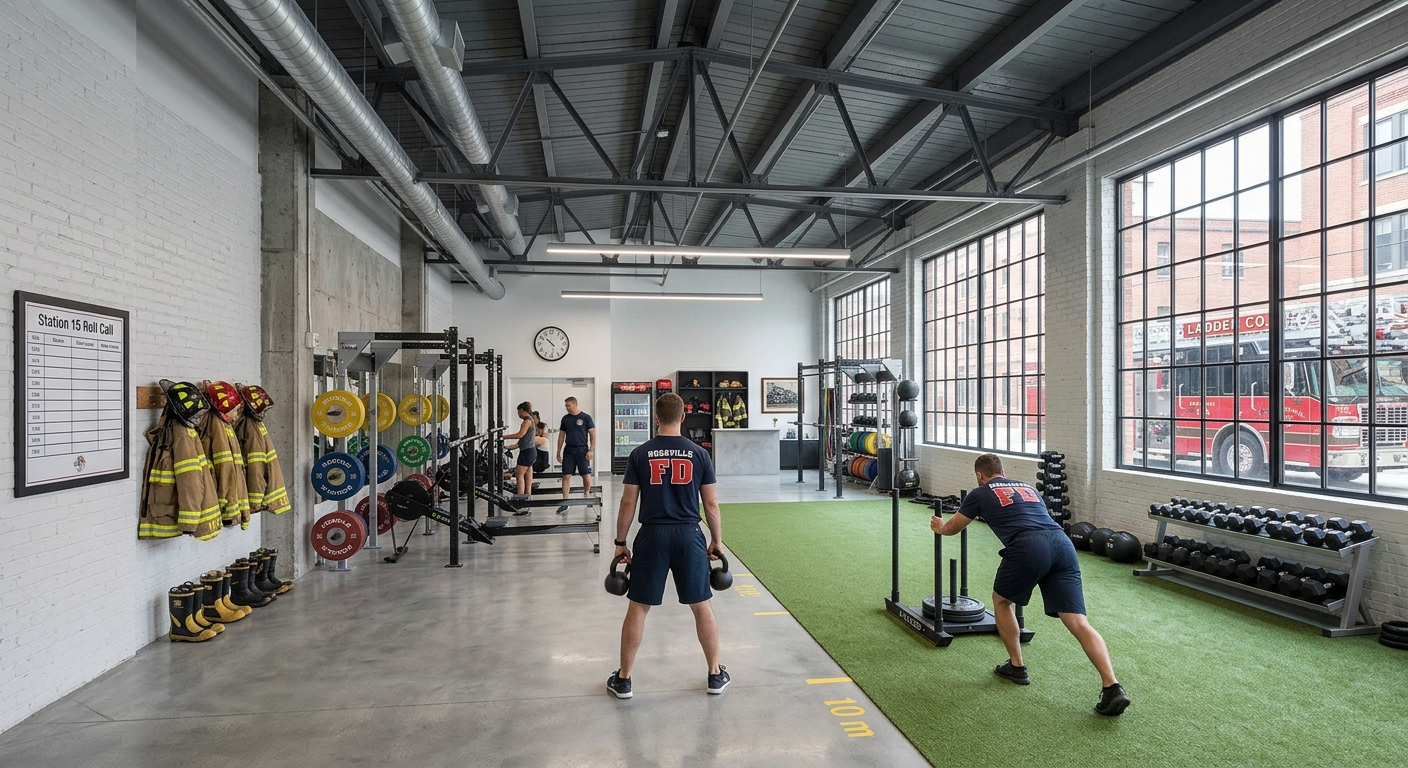
After more than three decades fitting out commercial gyms, I can tell you that fire stations are some of the most interesting spaces we work with. They aren't a corporate wellness room with a few treadmills and a mirror wall, and they aren't quite a private training facility either. A fire station gym has to serve a rotating crew working 24- or 48-hour shifts, accommodate wildly different body types and fitness backgrounds, survive around-the-clock use with minimal maintenance, and prepare firefighters for the actual physical demands of the job: dragging hose lines, carrying loaded packs up stairwells, forcing entry through a door, and pulling a downed colleague to safety. None of that looks like a bicep curl. If you're planning a fire station gym, equipment for a new build, a renovation, or just an overdue upgrade, the equipment selection process should start with function, not aesthetics.
I've had the chance to help outfit stations for departments up and down the West Coast, and one thing has stayed consistent: fire departments are some of the most loyal, low-maintenance commercial buyers we work with. Once a captain or wellness coordinator finds equipment that holds up to shift work and actually mirrors the demands of the job, they tend to stick with that brand for the next purchase, and the one after that. That's exactly why rope-pulling machines, heavy-duty racks, and functional trainers from brands like Ropeflex, Body-Solid, and Hoist show up again and again in station house gyms. This guide walks through how to think about the layout, what equipment actually earns its floor space, and how departments in the Sacramento region and the greater Tacoma and Seattle area are approaching these builds right now.
Why Fire Stations Need a Different Approach to Gym Design
Most commercial gym buildouts start with a demographic assumption: members who show up voluntarily, train on their own schedule, and can skip a day without consequence. A fire station gym doesn't get that luxury. The people using it are on shift whether they feel like training or not, they need to be ready to perform at full output within minutes of an alarm, and they're sharing equipment with colleagues who might be twenty years apart in age and completely different in training background. That means durability and simplicity have to come before variety. A machine that requires constant calibration or delicate handling doesn't belong in a bay-adjacent workout room where sweat, dust, and diesel exhaust are part of the daily environment.
The other major difference is movement pattern. Firefighting is a pulling, dragging, carrying, and climbing sport far more than it's a pushing or isolation sport. Grip strength, posterior chain endurance, and the ability to generate force while breathing hard under a self-contained breathing apparatus matter more than how much weight someone can bench. This is where a thoughtfully designed station gym starts to look different from a typical commercial floor plan, with rope training, sled-style pulling, and full-body cable work taking priority over rows of single-joint machines.
Rope Training: The Closest Equivalent to the Job Itself
If there's one category of equipment that has become almost synonymous with firefighter conditioning, it's rope pulling machines, and Ropeflex has built its entire business around that movement pattern. Ropeflex is a Silicon Valley manufacturer that builds 100 percent USA-made rope trainers using patented magnetic resistance that adjusts automatically based on how hard and how fast the user pulls. There's no motor to manage and no complicated console to learn. You pull, the resistance scales with your effort, and the machine reverses instantly when you change direction, which can mimic the unpredictable that firefighters can experience.
For a station with limited floor space, the Ropeflex OX2 RX2100 Beam/Frame Mountable Rope Pulling Drum is one of the smartest additions we recommend, since it mounts directly to an existing power rack or wall beam rather than taking up its own footprint. Stations that want a dedicated standing unit tend to gravitate toward the Ropeflex ORYX RX2500 Rope Pulling Machine, which handles high-volume, multi-user days without drifting out of calibration. Departments building an outdoor or apparatus-bay-adjacent training area, which is common in warmer climates and increasingly common even in the Pacific Northwest during dry summer months, often ask about the Ropeflex ORYX2 RX5500 Vertical Outdoor Rope Pulling Machine, which is weatherproofed for exactly that kind of exposure. For crews who want to combine rope pulling with a climbing surface, the Ropeflex APEX RX4400 Tread Climbing Rope Machine layers cardiovascular conditioning on top of the pulling movement, which is about as close as equipment gets to simulating a stairwell climb in full gear.
Racks and Strength Foundations That Survive Shift Work
Rope training builds the conditioning base, but a station gym still needs a strength foundation, and that almost always means a rack. This is where Body-Solid earns its reputation. Founded in 1989 and known for introducing the fitness industry's first lifetime warranty back in 1994, Body-Solid has built its name on durable, value-driven equipment that performs at a commercial level without the price tag of some competitors. That combination of toughness and accessibility is exactly what a municipal budget and a heavily used facility both need.
The Body-Solid Commercial Power Rack is a strong anchor point for any station strength area, with a fully enclosed four-post design that supports squats, presses, and pull-ups safely without requiring a spotter, which matters when crews are training solo between calls. For stations with a smaller footprint, the Body-Solid Commercial Extended Half Rack offers nearly the same safety and versatility in a more compact frame. If the department also wants a guided barbell option for crews with less lifting experience, the Body-Solid Pro Clubline Counter Balanced Smith Machine provides a controlled path for pressing and squatting movements, which is a smart addition in a facility where not every user has a strength training background. Rounding out the strength side, the Body-Solid GDCC250 Cable Crossover Functional Trainer adds dual-stack cable work for rotational core training and upper body pulling patterns that translate directly to hose handling and forcible entry tasks.
Functional Trainers for Full-Body, Multi-User Stations
Because a station gym is shared by an entire shift, and because different companies rotate through the same house over the course of a week, equipment that can serve a wide range of body types and goals from a single footprint is extremely valuable. This is where Hoist Fitness consistently earns a spot in our station house recommendations. Hoist has been engineering and manufacturing equipment in San Diego for decades and is one of the few major fitness brands still building domestically, with a commercial line found in military installations, universities, and professional sports facilities around the world, which tells you something about how it holds up under heavy institutional use.
The Hoist Fitness HD3000 Commercial Functional Trainer is a workhorse for stations that want one machine to cover chest press, rows, pulldowns, and rotational core work across a huge range of user heights and strength levels. For departments with a bit more space and a desire to combine a full rack with cable functionality, the Hoist Fitness Mi7 Functional Training System pairs a power rack, Smith-style guide rod, and dual adjustable pulleys into one connected training wall, which is an efficient way to give a small crew nearly everything they need without sprawling across the room. And for stations that want a heavier-duty, higher-capacity option built for near-constant rotation of users, the Hoist Fitness H-8 Functional Trainer is built with a larger weight stack and a more robust frame that holds up well in a multi-shift environment.

Planning the Floor Plan: Bays, Day Rooms, and Repurposed Space
Most fire stations weren't built with a dedicated fitness room in mind, so the equipment often ends up in a converted bay, a section of the apparatus floor, or a repurposed storage room. That reality should shape the equipment order just as much as the training goals do. Wall or rack-mountable options, like the Ropeflex OX2 drum mentioned earlier, are worth prioritizing precisely because they don't require their own floor footprint. Combination units like the Hoist Mi7 that fold a rack and a cable system into one structure also help when square footage is tight. It's worth measuring ceiling height carefully too, since pull-up stations and taller rack uprights can be a problem in a converted apparatus bay with lower clearance near support beams.
A few other practical considerations come up in nearly every station gym project we work on:
- Flooring matters more than people expect, since dropped plates and dragged equipment on a hard surface will chip concrete and shorten equipment life; rubber flooring underneath the strength area protects both the gear and the floor.
- Ventilation and diesel exhaust exposure should factor into where cardio and rope equipment gets placed, ideally away from apparatus bay doors where exhaust settles.
- A mix of body weights and experience levels across a shift means adjustable and multi-user equipment should take priority over single-purpose machines whenever the budget allows.
Serving Fire Departments Across Sacramento, Rancho Cordova, and the Pacific Northwest
We've had the chance to work directly with departments across the Pacific NorthWest, including stations in Rancho Cordova, CA on exactly this kind of build-out, and the pattern tends to repeat itself: a converted bay or day room, a rope trainer mounted to an existing beam or rack, a half rack or power rack as the strength anchor, and a functional trainer that can flex between crews. Sacramento's fire service community in particular has been ahead of the curve on functional and job-specific training, and it shows in the equipment requests we get from that region.
Tacoma and greater Seattle region, station gyms tend to deal with a different environmental challenge: limited outdoor training windows due to weather, which pushes more equipment indoors and puts a premium on space-efficient combination units like the Hoist Mi7 or a wall-mounted Ropeflex drum. Departments in wetter climates also tend to ask more questions about corrosion resistance and finish quality, which is one more reason Body-Solid and Hoist equipment, both built with commercial-grade coatings and hardware, tend to hold up well in that environment.
Budgeting, Financing, and Working With an Authorized Dealer
Municipal fire departments often work within tight capital budgets, grant cycles, or bond-funded renovation projects, and equipment purchases need to reflect that reality. As an authorized dealer for Ropeflex, Body-Solid, and Hoist, The Fitness Outlet offers factory-backed pricing along with valid manufacturer warranties, which matters enormously for a department that needs a piece of equipment repaired or replaced quickly rather than shipped back to a distributor for weeks. We also offer 0% financing through Affirm and commercial lease options with no money down, which have helped a number of departments spread a full station buildout across a budget cycle rather than waiting for a single large capital allocation.
If you're planning a new station or renovating an existing one, our team can walk through the specific footprint, ceiling height, shift schedule, and training goals for your house and put together a recommendation that balances durability, versatility, and cost. We've been doing this for fire departments and other commercial clients for more than 30 years, and station gyms are one of the areas where getting the equipment selection right has a direct, measurable impact on crew readiness and injury prevention.


Share:
Equipping Your PT Clinic: The Rehab Equipment Patients (and Referring Doctors) Notice
Power Plate vs Traditional Warm-Up: Which Gets You Ready Faster?