

Power Plate Warm-Up vs. Traditional Warm-Up: Which Gets You Ready Faster?
If you've spent any real time in a gym, you already know the ritual. Five minutes on a bike or treadmill, a round of leg swings and arm circles, maybe a few bodyweight squats, and only then do you feel like your body is actually ready to train. It works, but it's slow, and on a lot of days it's the first thing to get skipped when time is tight. After more than three decades around fitness equipment, trends come and go, but I have seen what actually holds up. I've come to see that warming up as one of the most under-optimized parts of some routines. There's a faster way to get there, and it's been sitting in physical therapy clinics and pro sports training rooms for over twenty years: whole-body vibration training on a Power Plate.
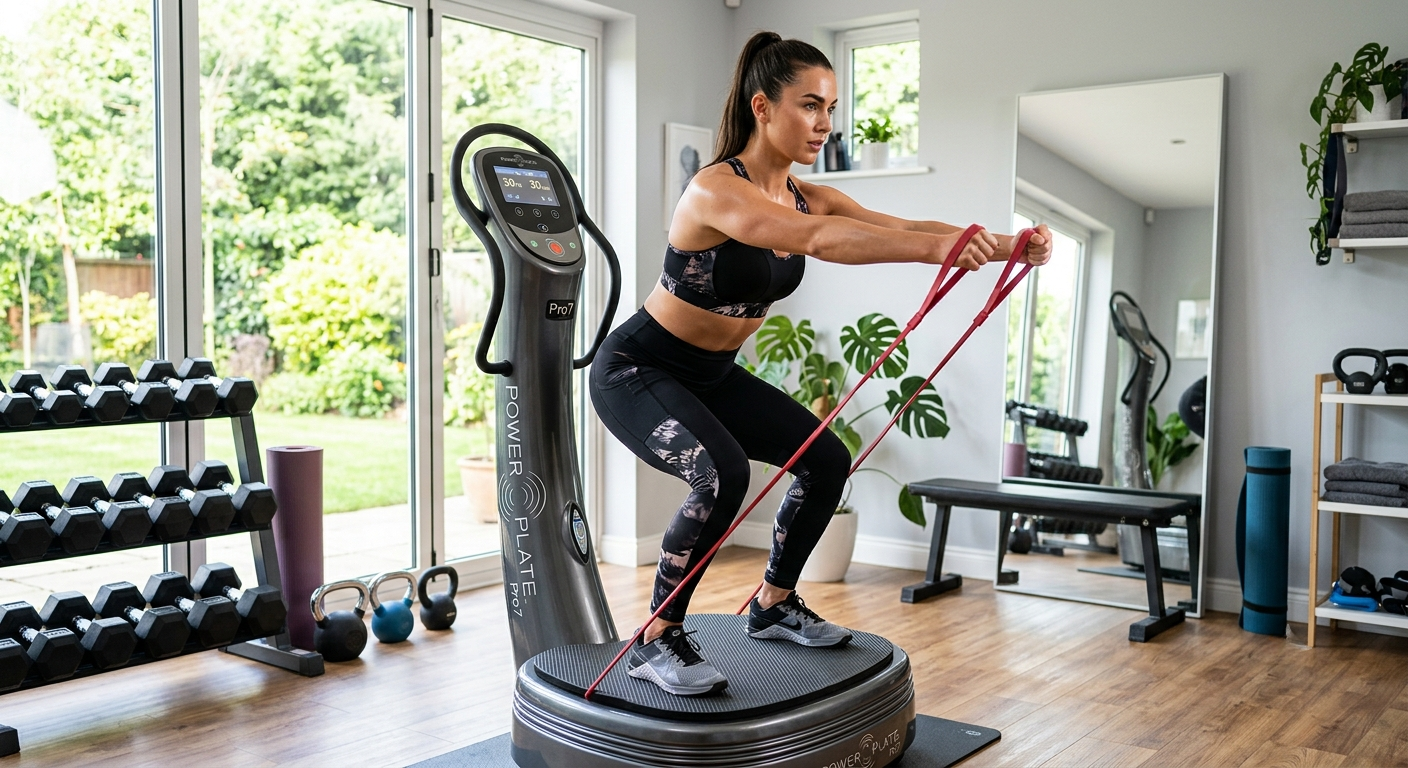
Power Plate machines use a patented technology called PrecisionWave, which sends controlled vibrations through the platform and into your body up to 50 times per second. Your muscles respond the way they would to a sudden loss of balance by contracting and relaxing reflexively, over and over and faster than you could ever trigger voluntarily. That reflexive activation is exactly what a warm-up is supposed to accomplish: waking up muscle fibers, increasing blood flow, and priming your nervous system for work. The difference is that a Power Plate warm-up does it in a fraction of the time a traditional warm-up takes. That is why it is worth understanding what a Power Plate can do for anyone who trains seriously, recovers from old injuries, or just wants to stop losing fifteen minutes of every gym session to cardio they don't particularly enjoy.
What a Traditional Warm-Up Is Actually Doing
Before comparing the two, it helps to understand what a conventional warm-up accomplishes physiologically, because the goal isn't just to "feel loose." A good warm-up raises your core and muscle temperature, which makes muscle tissue more pliable and reduces the risk of strains. It increases blood flow to working muscles, delivering oxygen and nutrients while clearing out some of the metabolic byproducts that build up during rest. It also activates the nervous system, essentially rehearsing the movement patterns you're about to use so your body recruits muscle fibers more efficiently once you start your actual workout.
The trouble is that all of this takes time, and it takes even more time if you're not disciplined about doing it right. Light cardio alone typically needs eight to ten minutes to meaningfully raise muscle temperature. Add in dynamic stretching and activation drills, and a proper warm-up can easily eat fifteen to twenty minutes before you've lifted a single weight. Most people don't have that kind of patience, and plenty skip the warm-up altogether or cut it down to a token thirty seconds of arm swings, which is really no warm-up at all.
Where Traditional Warm-Ups Fall Short
There's nothing wrong with a traditional warm-up in principle. The problem is consistency and efficiency. A few of the common gaps:
- Time cost. Between commuting, changing, and the workout itself, most people are looking for ways to shrink their gym time, not add to it.
- Incomplete activation. Light cardio warms up the cardiovascular system but doesn't necessarily activate the small stabilizer muscles that protect joints during heavier lifts.
- Boredom and skipping. A warm-up that feels like a chore is a warm-up that gets shortened or ignored, especially on busy days.
None of this means traditional warm-ups are useless, they're the default for a reason, and they work. But "works" and "efficient" aren't the same thing, and that gap is exactly where vibration training earns its place.

What Vibration Training Actually Does to Your Muscles
Whole-body vibration isn't a new science. It was originally developed for Russian cosmonauts to counteract muscle and bone loss in zero gravity, and it's been refined for clinical and athletic use for more than two decades. Power Plate's PrecisionWave technology delivers multi-directional vibrations through a platform you stand, kneel, or place your hands on. Your body's natural response to that vibration is called the tonic vibration reflex, an involuntary, rapid contraction-and-relaxation cycle in the muscle fibers being loaded.
Because that reflex happens so quickly and involuntarily, it recruits far more muscle fiber than most people activate through normal static stretching or light cardio. Research on the technology has found that a Power Plate can engage up to 138% more muscle activity compared to performing the same movement without vibration. That's not the goal of a warm-up, you're not trying to fatigue muscles before your workout, but it is exactly the mechanism that makes a short vibration session so effective at raising blood flow, muscle temperature, and neural readiness quickly. Even a five-minute session has been shown to noticeably improve circulation, which is one of the primary jobs a warm-up is supposed to do in the first place.
Power Plate Warm-Up vs. Traditional Warm-Up: The Real Comparison
Put the two side by side and the difference in time investment is the headline. A traditional warm-up sequence is usually light cardio, dynamic stretches, activation drills which generally takes twelve to twenty minutes to properly prepare your body for moderate-to-heavy training. A Power Plate warm-up accomplishes a comparable increase in muscle temperature, blood flow, and neuromuscular activation in five to ten minutes. The vibration is doing mechanical work your body would otherwise need repeated movement and time to achieve on its own.
There's also a quality difference worth mentioning. Traditional warm-ups rely on you executing movements correctly and consistently to get the activation benefit. If your dynamic stretches are lazy or your cardio pace is too easy, you're not getting the full effect. A Power Plate warm-up doesn't have that variability problem. The reflexive muscle response happens automatically once you're standing on the platform, so the quality of the warm-up doesn't depend on your form or motivation on a tired Monday morning. That consistency is a big part of why physical therapists and strength coaches have leaned on vibration platforms for pre-training prep and post-injury rehab for so long, it delivers a reliable stimulus every time, without asking the user to be a perfect mover.
None of this means a Power Plate warm-up needs to fully replace movement-based preparation. The most effective approach, and the one I usually recommend to customers setting up a home gym, combines both: a few minutes on the platform to get blood flowing and muscles firing, followed by two or three sport-specific movements. Usually bodyweight squats, light rows, or the actual first exercise of your workout at reduced load, to groove the movement pattern you're about to use. That combination gets you fully warmed up in well under ten minutes total, instead of twenty.
What a Power Plate Warm-Up Routine Actually Looks Like
A typical vibration warm-up doesn't require any special skill or programming. Standing directly on the platform in a slight squat with knees soft activates the quads, glutes, and calves simultaneously, and thirty to sixty seconds at a lower frequency setting is usually enough to get blood moving through the lower body. From there, most people move through a short sequence: a static or slightly dynamic lunge position to bring the hip flexors and hamstrings into play, a push-up or plank position with hands on the platform to warm up the shoulders and core, and a final round of light squats to bring everything together before moving to the main workout. Total time on the platform for a full-body warm-up is typically five to eight minutes, and most Power Plate home units come with a quick-start guide or preset programs that walk you through exactly this kind of sequence.
Choosing the Right Power Plate for a Warm-Up Routine
Not every vibration platform is built with the same priorities, and the right choice depends mostly on how much space you have and how serious your training is. For anyone just looking to add a fast, effective warm-up to an existing routine, the Power Plate Personal Vibration Trainer is the simplest entry point, a compact, portable platform with a fixed 35Hz frequency that's more than enough to get muscles firing before a workout, and small enough to tuck away in a closet between sessions.
If you want more control over intensity or plan to use the platform for recovery as well as warm-ups, the Power Plate MOVE steps things up with a variable 30–40Hz range, six workout modes, and a digital console that makes it easy to dial in exactly how much stimulus you want on a given day. For people building out a serious home gym who want a warm-up station that doubles as a stability and mobility tool, the Power Plate my5 offers a larger platform surface, stability handles, and the same clinical-grade PrecisionWave technology used in physical therapy clinics, backed by a three-year hardware warranty. And for anyone training at a genuinely elite level, or setting up a facility rather than a home corner, the Power Plate pro8 offers over 1,000 guided movements and a touchscreen console built for structured, coach-led programming.
Who Gets the Most Out of a Vibration Warm-Up
Time-crunched lifters aren't the only ones who benefit. Older adults working on balance and bone density often find a short vibration session gentler on the joints than a brisk warm-up walk, while still delivering meaningful circulation benefits. Athletes coming back from injury frequently use vibration platforms as a low-impact way to reintroduce loaded movement without stressing healing tissue. And anyone managing chronic tightness, desk workers with cranky hips or runners with stiff calves, tend to notice that a few minutes of vibration loosens things up faster than static stretching alone ever did.
If you're local to Sacramento or Rancho Cordova, our showroom carries several Power Plate models on the floor, and it's worth stopping in to actually feel the difference between the frequency settings before deciding which one fits your routine. A fixed 35Hz platform feels noticeably different underfoot than a variable model dialed up to 40Hz. The same goes for anyone near our Tacoma and Seattle-area customers; our team there can walk you through the same hands-on comparison so you're not guessing based on spec sheets alone.
Getting Started Safely
Vibration training is well-tolerated by most healthy adults, but it's not universally appropriate. If you're pregnant, have a pacemaker or other implanted medical device, have recently had surgery, or manage any other condition, talk to your doctor before adding vibration training to your routine. For most people, starting is as simple as stepping onto the platform at a lower frequency setting, keeping sessions short at first and gradually increasing time and intensity as your body adapts. Like any new training tool, it's worth easing in rather than jumping straight to the highest setting on day one.
The bigger picture here isn't that vibration training makes traditional warm-ups obsolete. It gives you a genuinely faster, more consistent way to get your body ready to train, which matters most on the days when a full fifteen-minute warm-up simply isn't going to happen. Whether that means adding a Power Plate to an already-packed home gym or picking one up specifically to solve the warm-up problem, it's one of the more practical upgrades we sell, and one that tends to get used far more often than people initially expect.

Share:
How to Design a Fire Station Gym: Equipment Built for Functional Fitness
How to Build a High-Performance Athletic Training Room