


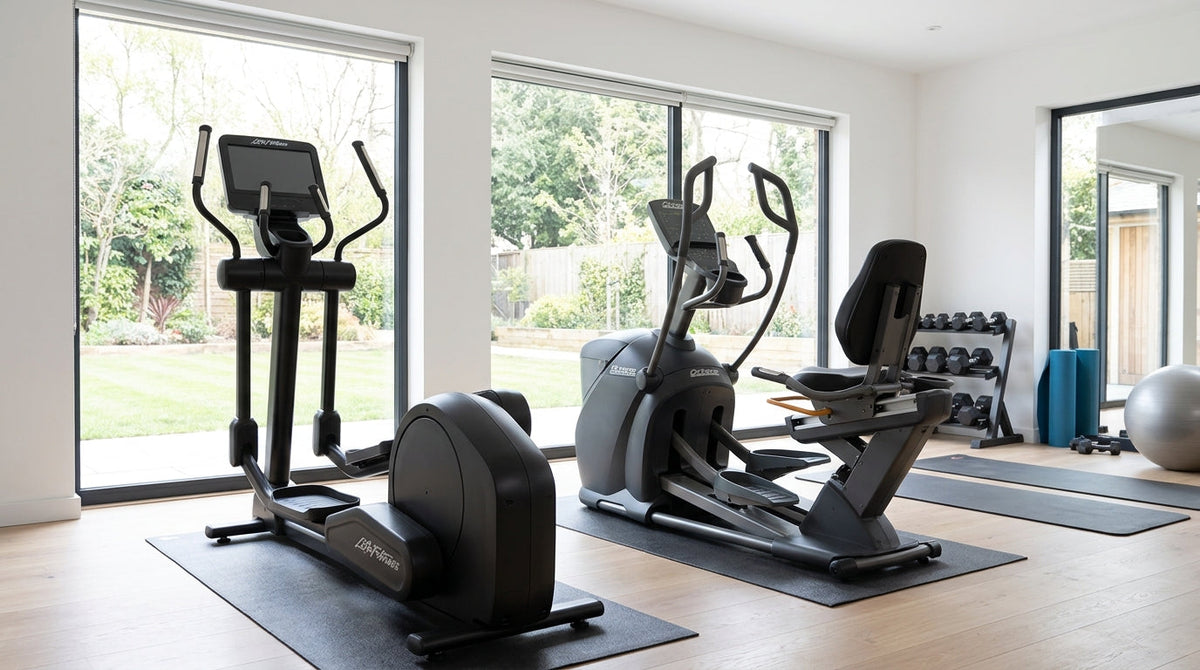

Is a seated or standing elliptical better for home exercisers?
A seated elliptical may suit someone who prefers exercising with seat and back support and less demand for standing balance. A standing elliptical may suit someone comfortable exercising upright who prefers traditional elliptical movement. The better choice depends on access, comfort, fit, and individual exercise preferences, not age alone.
Choosing an elliptical for home use isn't only about resistance levels or workout programs. For many home exercisers, the more useful question is how manageable the machine will feel in everyday use. Seated and standing ellipticals offer different positions, access requirements, and movement patterns. Understanding those differences can help you narrow your options before buying.
How Seated and Standing Ellipticals Differ
A standing elliptical places you upright on moving pedals. Many models have moving handlebars for upper-body participation. A seated or recumbent elliptical lets you exercise from a supported seat with pedals positioned in front of you. Both can provide cardiovascular exercise, but the posture, access, and movement feel different.
1. Getting On and Off
With a seated elliptical, you generally sit before starting the pedal motion. Check the seat height, clearance around the frame, and whether you can comfortably reach the pedals. With a standing elliptical, you step onto raised foot platforms; the step-up height, stationary handle placement, and stability of the pedals all matter. Neither design should be assumed universally easier to access.
2. Seat Comfort, Posture, and Support
Seated ellipticals can provide back support and may appeal to shoppers who prefer not to stand throughout a workout. Standing ellipticals require an upright, weight-bearing position and may feel more similar to walking or climbing. Evaluate which position feels comfortable for the length of workout you expect to do.
3. Balance and Handlebar Design
On a standing elliptical, stationary handles can help with positioning, while moving handles are intended for exercise movement rather than guaranteed balance support. Seated models may offer side handles, moving handles, or both. Look at handle reach, grip position, and whether the controls can be operated without stretching awkwardly.
4. Pedal Movement and Stride Feel
Standing ellipticals guide the feet through a repeating path beneath the body; stride length and pedal spacing influence the feel. Seated ellipticals guide the legs through a motion in front of the seat. Because body position changes the movement experience, it is worth trying both styles when possible rather than assuming one will feel better.
5. Resistance and Everyday Controls
Both designs can offer adjustable resistance and workout programs, depending on the model. Straightforward controls, readable displays, and the ability to begin at a comfortable effort can be more important than having many advanced programs. Verify the exact capabilities of any model you are considering.
Seated vs. Standing Ellipticals: Side-by-Side Comparison
| What to compare | Seated elliptical | Standing elliptical |
|---|---|---|
| Exercise position | Seated, typically with back support | Upright and weight-bearing |
| Getting into position | Sit before beginning pedal motion | Step onto raised pedals |
| Balance demands | Less standing balance required during exercise | Requires comfortable upright balance |
| Movement feel | Guided leg motion in front of seat | Guided stride beneath body |
| Fit priorities | Seat position, pedal reach, handles | Step-up access, stride, handles |
| Upper-body movement | Available on some models | Common with moving-handle models |
Four Ellipticals to Compare at The Fitness Outlet
These four models give you two seated and two standing options. Start with the exercise position you prefer, then compare access, fit, handles, and resistance. Check each product page for the latest dimensions and specifications.

Octane Fitness XR6 Seated Elliptical Trainer
Compare if: You want a seated elliptical with back support and a step-through design; compare the seat position and pedal reach.

True Fitness Gravity Recumbent Elliptical
Compare if: You prefer seated, low-impact movement and want to compare its step-through access and adjustable seat.

Life Fitness Atmos Elliptical
Compare if: You prefer upright elliptical workouts and want to compare its fixed stride, total-body handles, and console options.

Star Trac 6 Series Cross Trainer
Compare if: You want an upright cross trainer and would like to compare handle motion, resistance adjustments, and overall fit.
For seated training, compare the Octane Fitness XR6 with the True Fitness Gravity for seat adjustment, mounting access, and how the guided movement feels. For upright training, compare the Life Fitness Atmos with the Star Trac 6 Series for stride feel, handles, controls, and space requirements.
What to Check Before Buying
Access: Make sure you can approach the equipment and get into and out of position comfortably.
Fit: Check seat or stride positioning, pedal reach, and handle placement.
Space: Compare assembled dimensions and recommended clearance.
Controls: Look for readable displays and convenient resistance adjustments.
Shared use: Consider whether everyone using the machine can achieve a comfortable fit.
Delivery: Plan the route to the workout room and any assembly needs.
Which Elliptical Should You Choose?
A seated elliptical may be appealing if you prioritize back support or prefer to exercise without standing. A standing elliptical may suit you if you are comfortable exercising upright and enjoy traditional elliptical motion. Age alone shouldn't decide the choice. If you have significant balance concerns, a medical condition, or questions about which movements are appropriate, consult a qualified healthcare professional.
Bottom Line
The best elliptical is the one that fits your body, your space, and the way you want to exercise. Start with seated support versus upright movement, then compare mounting access, handle placement, pedal feel, resistance, and adjustments. A comfortable, manageable machine is more likely to become part of your routine.

Share:
What Makes a Premium Elliptical Worth It? 7 Features to Compare Before You Buy