

How to Build a High-Performance Athletic Training Room
After more than three decades spent fitting out everything from small college weight rooms to full-scale collegiate performance centers, I can tell you the difference between a training room that produces results and one that just holds equipment usually comes down to planning, not budget. I've walked into six-figure facilities that athletes avoid because the layout fights the workout, and I've seen modest rooms outperform them simply because every piece of equipment earned its spot on the floor. If you're an athletic director, strength coach, or facilities manager tasked with building or renovating a training space, this guide walks through the equipment categories, layout logic, and sequencing that separate a functional room from a high-performance one.
Define the Room's Job Before You Buy Anything
Every athletic training room serves a specific mix of athletes, sports, and seasons, and that mix should dictate your equipment list long before you start browsing catalogs. A university strength and conditioning center supporting football, volleyball, and track has very different throughput needs than a sports club running small-group performance training or a high school weight room shared across a dozen teams. Before committing to a layout, walk through how many athletes will train simultaneously, how many sports you're supporting, and whether the space needs to flex between team lifts, individual rehab sessions, and off-season conditioning blocks. I've seen departments overspend on flashy machines and underspend on the racks and platforms that see daily use across every sport in the building. Get the utilization picture right first, and the equipment decisions will get easier.
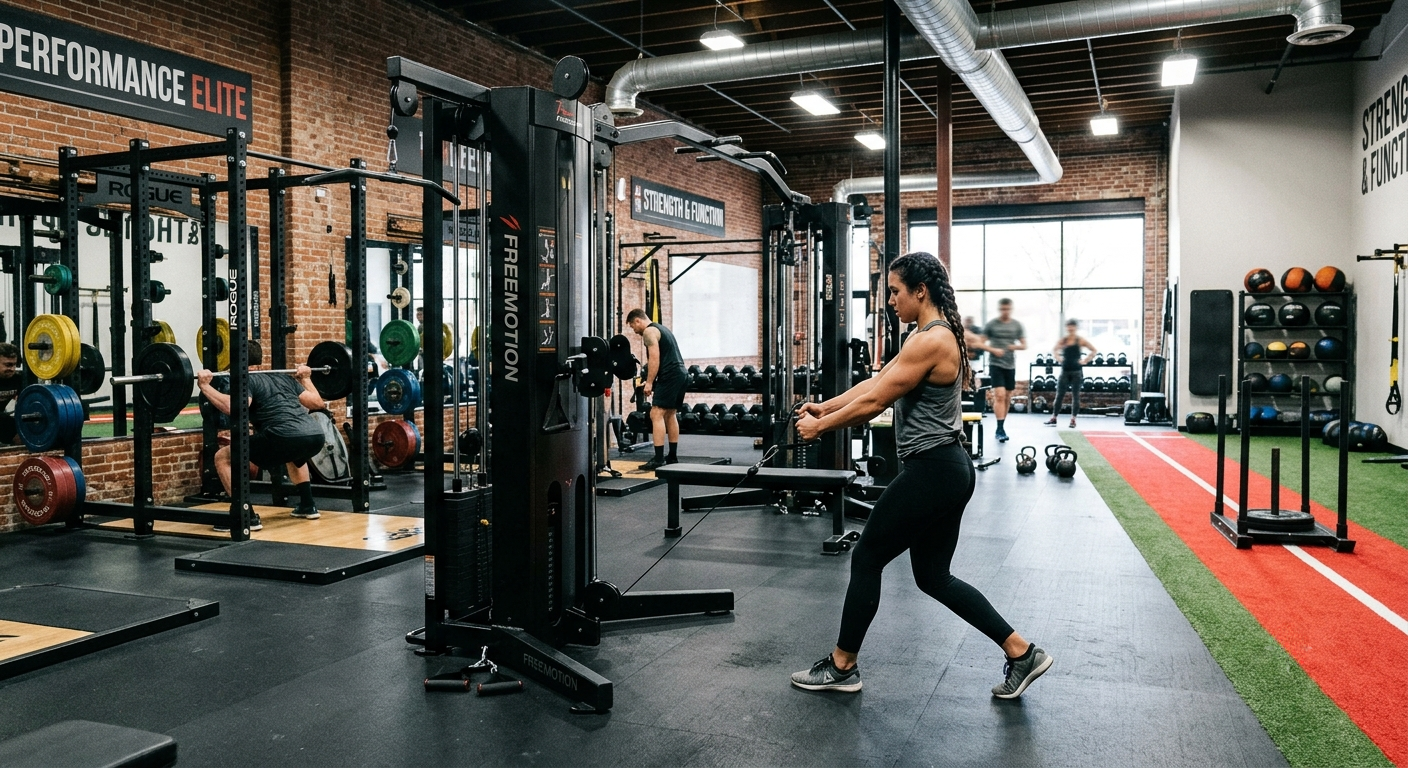
It also helps to think in terms of stations rather than square footage. A well-designed training room typically organizes into a free-weight and rack zone, a cable and functional training zone, a conditioning or rope-pulling zone, and a recovery zone. Mapping those zones on paper, even roughly, before you order anything prevents the common mistake of buying equipment first and figuring out placement later.
Functional Trainers: The Backbone of Movement-Based Training
If there's one category I'd never let a training room go without, it's a quality functional trainer. These dual-adjustable-pulley systems let athletes train pressing, pulling, rotational, and single-arm patterns that closely mirror what happens on the field or court, which is exactly why sports medicine staff and strength coaches lean on them so heavily for both performance work and return-to-play progressions. Because the cable resistance loads the body through natural movement arcs rather than a fixed bar path, functional trainers also tend to be more forgiving for large, mixed-ability groups moving through a circuit at the same time.
For departments outfitting a shared training room, the Hoist Fitness HD-3000 Commercial Functional Trainer is a workhorse we place often in high-traffic athletic settings. It's built for continuous daily use across multiple teams. The TRUE Fitness FT-900 Functional Trainer is another commercial-grade option engineered specifically for the wear and tear of institutional environments, with smooth cable resistance that holds up over years of programming changes. If footprint is tight, the BodyCraft HFT Pro Functional Trainer delivers commercial-caliber performance in a more compact frame, which matters in training rooms where every square foot is negotiated between sports. You can compare the full lineup on our commercial functional trainer and cable machine collection.
A well-placed functional trainer against a wall, with clearance on both sides for lateral and rotational movement, becomes one of the busiest stations in the room. It's worth giving it more floor space than you initially think it needs.
Rope Pulling Machines: Conditioning That Coaches Actually Trust
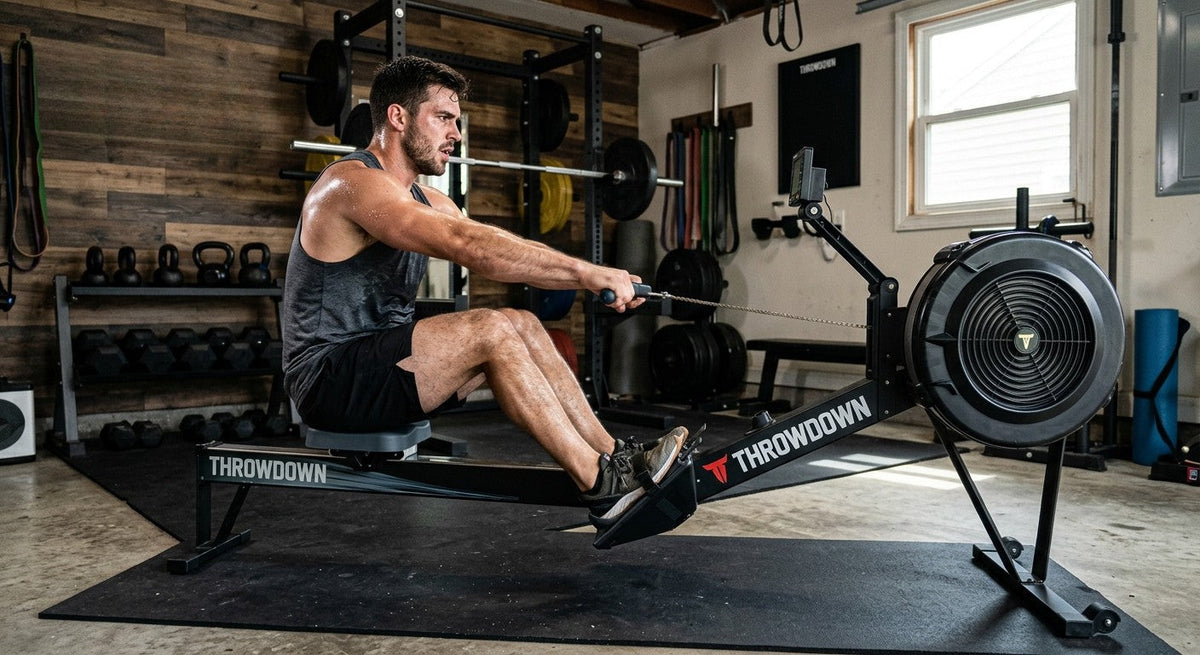
Rope pulling machines have become one of the fastest-growing categories in athletic training rooms, and for good reason. They deliver a demanding, joint-friendly conditioning stimulus that builds grip strength, upper-body pulling power, and cardiovascular capacity without the impact stress of traditional running-based conditioning. For sports with heavy pulling demands such as wrestling, rowing, football linemen, any combat sport, a rope trainer often becomes the single most-used piece of equipment in the building outside of the racks.
The Ropeflex ORYX RX2500 automatically scales resistance from roughly 10 to 200 pounds based on pulling speed and intensity, which makes it just as useful for a freshman building work capacity as it is for a conference-level athlete chasing peak output. If you want a machine that layers in lower-body movement alongside the pull, the Ropeflex VORTEX RX3300 uses an adjustable incline to blend upper and lower body functional work into a single station, which is a smart way to get more training value out of a limited footprint. Both machines hold up well under the kind of daily, multi-team rotation that a shared training room demands, and you can browse the rest of the lineup through our rope pulling machine collection.
Because rope trainers tend to draw a crowd during conditioning blocks, plan for sound and floor space. The pulling motion needs a clear runway, and coaches often want room to stand beside the athlete for cueing.
The Strength Core: Racks, Platforms, and Free-Weight Systems
No training room is high-performance without a strength core built around racks and platforms that can handle years of heavy, daily loading across an entire athletic department. This is the category where I tell departments not to cut corners, because a rack that flexes or wobbles under max-effort work isn't just an inconvenience, it's a safety liability.
Commercial-grade racks built from heavy-gauge steel with reinforced uprights are worth the investment. The Torque TR2 Power Rack is designed specifically for heavy, high-volume programming, with a reinforced frame and cast-iron leveling feet that add stability under serious load. The TKO Power Rack with Storage uses 3x3-inch commercial-grade steel uprights with a laser-cut numbering system that speeds up setup between athletes. Aa small detail that saves real time during team lifts. For departments needing a rated-capacity option built for the long haul, the BodyCraft F730 Power Rack, rated up to 1,200 pounds, is a dependable anchor for a strength zone. You can compare configurations across our commercial cages and racks collection.
Beyond the racks themselves, plan for:
- Adequate spacing between rack stations for safe spotting and bar loading on both sides
- Platform flooring rated for Olympic lifting and dropped weight, especially near your rack and platform zone
- A dedicated storage plan for plates, bars, and attachments so equipment doesn't end up staged in walkways
Getting these fundamentals right protects both your athletes and your equipment investment over the long run.

Recovery: The Category Most Training Rooms Underbuild
If I had to name the single most underfunded category in athletic training rooms, it would be recovery. Departments will spend generously on machines that build performance and then treat recovery tools as an afterthought, even though recovery capacity directly affects how much training load an athlete can absorb before the next session. A training room that helps athletes recover faster gets more usable training days out of every athlete, every season.
Simple, durable recovery tools go a long way here. The GoFit Foam Roller at 36 by 6 inches is a staple for pre- and post-training self-myofascial release and comes with a training manual, which makes it easy for athletic trainers to standardize technique across a whole roster. The GoFit Foot & Hand Recovery Massage Roller targets plantar fasciitis and tired hands and forearms, both common complaints among athletes putting in heavy training volume. For departments looking to build out a full recovery zone, our recovery equipment collection covers everything from mobility tools to more advanced modalities, and our cold plunge resources are worth a look if your program is exploring contrast therapy as part of a broader athlete care strategy.
Even a modest recovery corner, a few rollers, a stretching mat area, and clear signage on protocols, signals to athletes that recovery is part of the program, not an optional extra.
Layout, Flow, and Flooring
Equipment selection only pays off if the room is laid out so athletes and coaches can move through it efficiently. I generally recommend grouping your free-weight and rack zone along a load-bearing wall with clear sightlines for coaches, keeping functional trainers and cable stations along a separate wall where lateral movement won't cross paths with barbell work, and giving rope pulling machines and conditioning equipment their own corner with a clear runway. Recovery areas work best somewhat removed from the loudest zones, since athletes need a lower-stimulation space to actually decompress.
Flooring deserves its own line item in the budget. Rubber flooring rated for dropped weight under racks and platforms, combined with lighter-duty flooring in cable and recovery zones, protects both your subfloor and your equipment. Skimping here is one of the most common regrets I hear from facilities managers a year or two after opening a new room.
Serving Athletic Departments Across the Region
We work with school districts, universities, and performance centers well beyond our home base, and we've built out training rooms for programs across the Sacramento and Rancho Cordova area as well as athletic departments up in the Tacoma and greater Seattle region. Whether it's a full new-build weight room for a growing high school program or a phased upgrade to an existing university strength center, our team handles sourcing, freight logistics, and installation coordination so athletic departments aren't managing multiple vendors across a single project. We can also help coordinate delivery timing around your academic calendar, which matters when a training room needs to be ready before preseason.
Budgeting and Phasing the Build-Out
Very few athletic departments fund an entire training room in one budget cycle, and that's okay. A phased approach often produces a better result because you can learn from how athletes actually use the space before committing to the next round of equipment. A reasonable phase-one investment typically covers your rack and platform core plus one functional trainer, since these see the heaviest daily use across every sport. Phase two often adds rope pulling machines or additional cable stations once conditioning needs become clearer. Recovery tools are inexpensive enough to fold into almost any phase, and I'd encourage departments to do exactly that rather than pushing recovery.
Whatever your timeline, working with a supplier who understands institutional purchasing, quotes, freight coordination, warranty support, and installation scheduling around your season will make the entire process considerably less stressful than piecing equipment together from multiple vendors.
Building a Room Athletes Actually Want to Use
The best athletic training rooms I've helped build over the years share a common trait: athletes want to be there. That comes from thoughtful equipment selection matched to your actual sports and roster size, a layout that respects how athletes move through a session, and a recovery zone that gets treated as a real part of the program rather than an afterthought. Get those three things right, and the equipment list takes care of itself.
If you're planning a new training room or upgrading an existing one, our team can help you build an equipment plan matched to your sports, roster size, and budget. Reach out to The Fitness Outlet and we'll walk through it with you.


Share:
Power Plate vs Traditional Warm-Up: Which Gets You Ready Faster?
Spirit XT685 Treadmill Review