


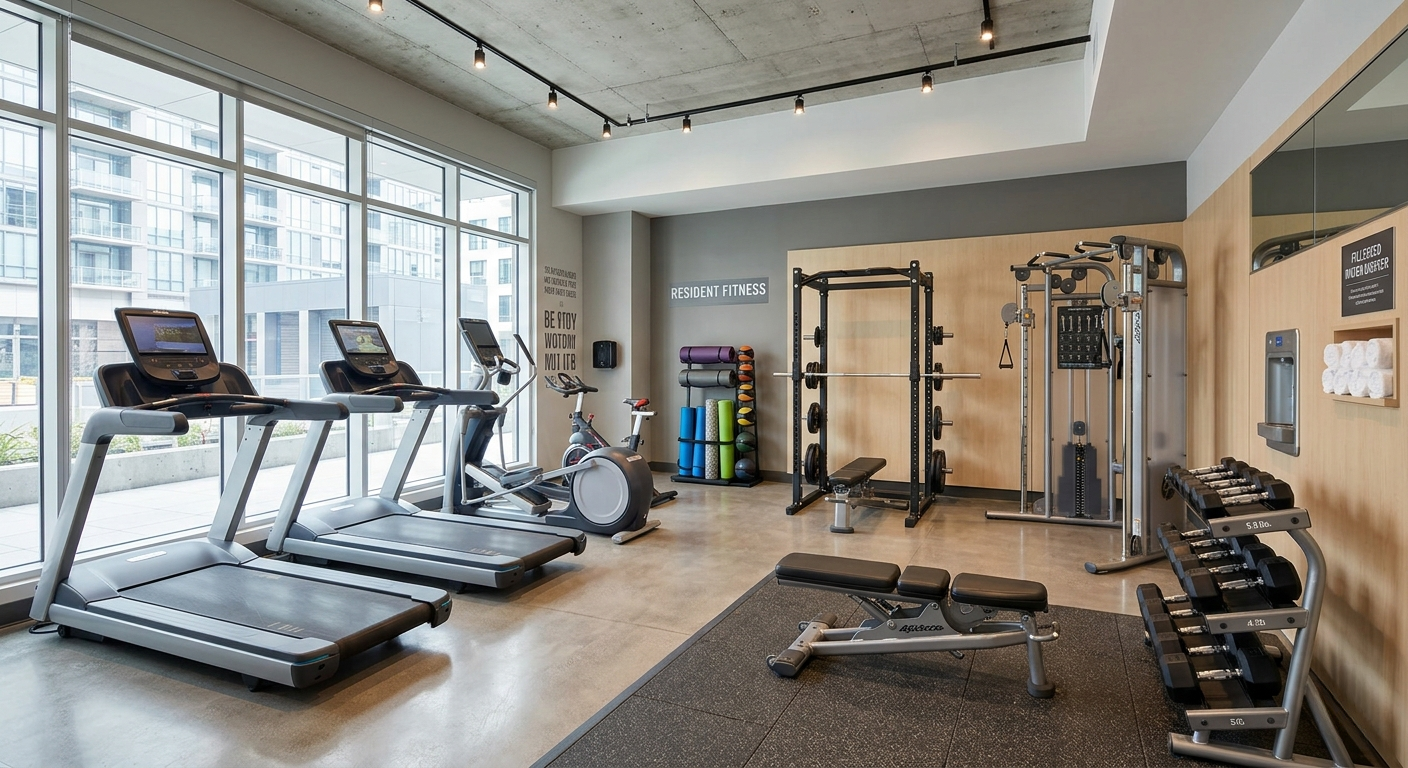
How to Equip an Apartment Building Gym on Any Budget
If you manage or own a multifamily property, you already know the fitness center isn't a nice-to-have anymore, it's one of the first amenities prospective renters ask about during a tour. After thirty-plus years selling and specifying equipment for everything from boutique studios to 400-unit luxury communities, I can tell you the biggest mistake property owners make isn't spending too little. It's spending in the wrong order. They drop their entire budget on one flashy treadmill and end up with a room that looks empty and gets used by almost nobody.
The good news is that a genuinely effective apartment gym doesn't require a six-figure buildout. It requires a plan. Whether you're working with a tight capital improvement budget or building out a brand-new amenity space designed to compete with luxury high-rises, the equipment you choose should match how your actual residents train, not how a gym influencer trains. Below, I'll walk through how to build a resident fitness center at three different budget tiers, what to prioritize at each level, and where a little extra spend pays for itself in renter satisfaction and retention.
Why Amenity Gyms Are No Longer Optional
Multifamily fitness centers used to be an afterthought. A few dumbbells and a mirror wedged into a leasing office corner. Renters increasingly compare amenity packages the way they compare unit finishes, and a tired, half-broken gym sends a message about how the rest of the property is maintained. On the flip side, a clean, well-equipped fitness center with commercial-grade machines tells a prospective tenant that management invests in the things residents actually use every day.
This matters most in markets with heavy apartment competition. In fast-growing rental corridors like Sacramento and nearby Rancho Cordova, where new mid-rise and garden-style communities are constantly competing for the same renter pool, amenity quality has become a genuine differentiator. The same is true up in the Tacoma and greater Seattle area, where dense multifamily development means residents have plenty of options and will absolutely walk a building if the fitness room feels like an afterthought. A well-planned gym isn't just an expense line, it can be used as a leasing tool.
What Apartment Residents Actually Use (and What They Skip)
Before talking budget tiers, it helps to know how multifamily fitness rooms actually get used, because it's different from a commercial health club. Most residents are doing one of three things: a short cardio session, a basic strength circuit, or a quick stretch and mobility routine before or after work. Very few are training for a powerlifting meet. That means your dollars are best spent on equipment that's intuitive, low-maintenance, and durable enough to handle constant, unsupervised use, not on highly specialized gear that only a fraction of residents will ever touch.
This is also why hospitality-grade and light-commercial equipment exists as its own category, separate from full commercial gym gear. It's built for shared, frequent use by people with a wide range of fitness experience, with simple controls and forgiving designs.
Building a Gym on a Starter Budget
If you're working with a modest renovation budget or outfitting a smaller property, the goal is coverage, not volume. You want one solid strength option, one or two cardio pieces, and enough flexibility for residents to do a full-body workout without feeling like the room is missing something obvious.
For strength, a compact multi-station unit like the Hoist 4 Station Single Pod CMJ6000-1 is one of the smartest investments at this tier. It's a cable-based jungle gym that handles presses, pulls, and core work in a single connected footprint, and because it's modular, you can expand it to a 9-station or 14-station configuration later if your budget grows or your resident base does. Pair it with a TKO Signature Flat Bench and a basic dumbbell selection on a TKO 2-Tier Horizontal Dumbbell Rack, and you've covered the vast majority of strength training requests without crowding the room.
A few other starter-budget priorities worth calling out:
- A single quality treadmill will get more daily use than almost any other piece of equipment, so don't skip cardio entirely to save money on strength gear.
- Rubber flooring under any strength station protects subfloors and reduces noise transfer to units above and below, a real concern in wood-frame multifamily construction.
- Leave visual breathing room. A half-empty room with two great machines reads as intentional; a packed room with five mediocre ones reads as cluttered.
Stepping It Up: The Mid-Range Apartment Gym
Once you've got more room in the budget, typically in the $8,000 to $20,000 range depending on property size, you can start building a fitness center that feels genuinely competitive with newer construction. This is where I usually recommend bringing in a true multi-station home gym and at least one commercial-grade cardio machine with a real console, rather than a big-box treadmill that won't survive eighteen months of daily resident use.
The Hoist H2200 2 Stack Multi Gym is a strong fit here. Its dual 200-lb. Silent Steel weight stacks mean two residents can train at once without waiting on each other, which matters during peak evening hours in a busy building. On the cardio side, the True Fitness Launch Treadmill brings True's signature low-impact deck and HRC Heart Rate Control into a compact, residential-friendly footprint, while the True Fitness Launch Upright Bike gives residents a lower-impact option that's especially popular with older tenants or anyone easing back into a routine.
For functional and mobility-focused residents the Prism Fitness Smart Essential Self-Guided Package is worth a serious look. It's a self-contained storage tower with guided workout cards, so residents who've never set foot in a gym can follow a structured routine without needing staff supervision. That self-guided design is exactly what hospitality and multifamily environments need, since most properties don't have a trainer on-site to walk people through proper form.
At this tier, I'd also recommend adding a proper adjustable bench, the TKO Signature Multi-Adjustable Bench handles flat, incline, and near-vertical positions and is built for the kind of frequent, varied use you'll see in a shared community gym.
Going All-In: Premium Amenity Gyms That Compete for Renters
For Class A properties, new construction, or any community where the fitness center is meant to be a headline amenity, it's worth investing in equipment that would feel at home in a boutique studio. This is the tier where finishes, quiet operation, and brand recognition start to matter as much as raw functionality, because residents touring the building will notice the logos on the machines.
The Hoist H4400 4 Stack Multi Gym is a genuine workhorse at this level, with four dedicated stations, leg press, adjustable cable column, lat pulldown, and a combined chest press, mid row, and leg extension station, built into light-commercial-grade construction that can handle continuous, unsupervised use across a large resident base. If your property has the space and the demand, the Hoist CF3367 Squat Rack adds a real free-weight training zone that more serious residents will specifically seek out, and it's available in finishes like matte black and platinum that can be matched to your fitness room's design.
On the cardio side, stepping up to the True Fitness Gravity+ Treadmill gets you a commercial-duty 5 HP AC drive motor and a maintenance-free, reversible deck built to hold up under continuous daily resident use. Its proprietary FITX Impact System cushions every stride, which keeps the running surface comfortable on joints while quietly reducing the vibration and noise that travel into adjacent units. A real consideration in stacked residential construction. The Gravity+ also adds true incline and decline capability in a space-optimized frame, giving residents the kind of workout variety usually reserved for full-size commercial health clubs, without requiring a commercial-sized footprint.
For properties that want a standout, photo-ready centerpiece in a smaller footprint, the Throwdown FXD Bench with Accessories is one of the more interesting options on the market right now. It's a self-contained, compact training system that packs an impressive range of exercises into a footprint that works even in a tighter amenity room, a smart pick for properties that want premium functionality without needing a warehouse-sized fitness center.

Space, Noise, and Floor Plan Considerations for Multifamily Properties
Equipment selection only solves half the problem. Apartment fitness centers live inside shared buildings, which means noise transfer, ceiling height, and electrical access all factor into what you can realistically install. Treadmills and ellipticals generate continuous low-frequency vibration, so rubber flooring with adequate underlayment isn't optional if there are units directly above or adjacent to the gym. Free-weight zones need impact-rated flooring for the same reason, especially if residents are dropping dumbbells or loading barbells.
Layout matters just as much as equipment choice. Cardio machines do best along a wall with sightlines to a TV or window, since residents tend to stay longer when they have something to look at. Strength equipment should be grouped so spotting and circulation paths don't cross cardio traffic. And if your fitness room doubles as a leasing tour stop which it often does, keep enough open floor space that the room photographs well even when only one or two pieces of equipment are in use.
A Sacramento, Rancho Cordova, and Tacoma/Seattle Perspective
Local market conditions genuinely change the calculus here. In Sacramento and Rancho Cordova, where a wave of newer garden-style and mid-rise communities has pushed amenity expectations up significantly over the past several years, property managers are often competing directly with buildings that opened with brand-new fitness centers. In that environment, even a mid-range refresh, a new multi-station gym plus a commercial treadmill can meaningfully change how a property is perceived during a tour, especially against older competitors that haven't touched their fitness room in a decade.
In the Tacoma and broader Seattle area, the calculus shifts slightly toward space efficiency and noise control. Many of the multifamily projects in this region are higher-density, wood-frame, or podium-style construction where sound transmission between floors is a real and frequent resident complaint. Properties here tend to benefit most from quieter, lower-impact equipment, recumbent bikes, well-cushioned treadmills, and rubber-flooring strength zones paired with smart layout choices that keep the loudest activity (free weights, jump training) away from shared walls.
Whichever market you're in, the equipment decisions above should flex around your building's actual construction and your residents' actual habits, not a generic gym checklist.
Maintenance, Warranties, and Working with a Commercial Equipment Partner
One thing that separates a fitness center that still looks great in year three from one that looks tired after twelve months is the buying decision made on day one. Commercial and hospitality-grade equipment is engineered for warranty terms and duty cycles that match shared, unsupervised use. Residential-grade gear simply isn't, no matter how good the price looks upfront. Pay attention to weight stack and motor warranties specifically, since those are the components that fail first under heavy daily use, and ask whether delivery and assembly are included, since improperly assembled multi-station gyms are one of the most common sources of early equipment failure and service calls.
It's also worth building a relationship with a supplier who understands multifamily and hospitality environments specifically, rather than a general sporting goods retailer. The equipment needs, financing structures, and service expectations for an apartment fitness center are different from a single-family home gym, and a partner who works across hotel, resort, and residential community installations will steer you toward gear that's actually built for the job.
Final Thoughts: Building the Right Gym for Your Property
There's no universal "right" fitness center for an apartment community. There's only the right one for your property, your residents, and your budget. A starter-tier room built around a compact multi-station gym and a couple of well-chosen cardio pieces can genuinely satisfy most residents' needs. A mid-range buildout adds capacity and self-guided functional training that broadens who actually uses the space. And a premium amenity gym, built around true commercial-grade strength and cardio equipment, becomes a leasing differentiator in competitive markets.
The throughline across every budget tier is the same: buy equipment built for shared, frequent, unsupervised use, plan your layout around noise and space constraints specific to your building, and resist the temptation to overspend on one showpiece machine at the expense of overall coverage. Do that, and your fitness center stops being a line item and starts being one of the amenities residents actually mention when they renew their lease.

Share:
Best Exercise Equipment for Seniors: Low Impact, High Results
Massage Chair Buyer's Guide: How to Choose the Right One