

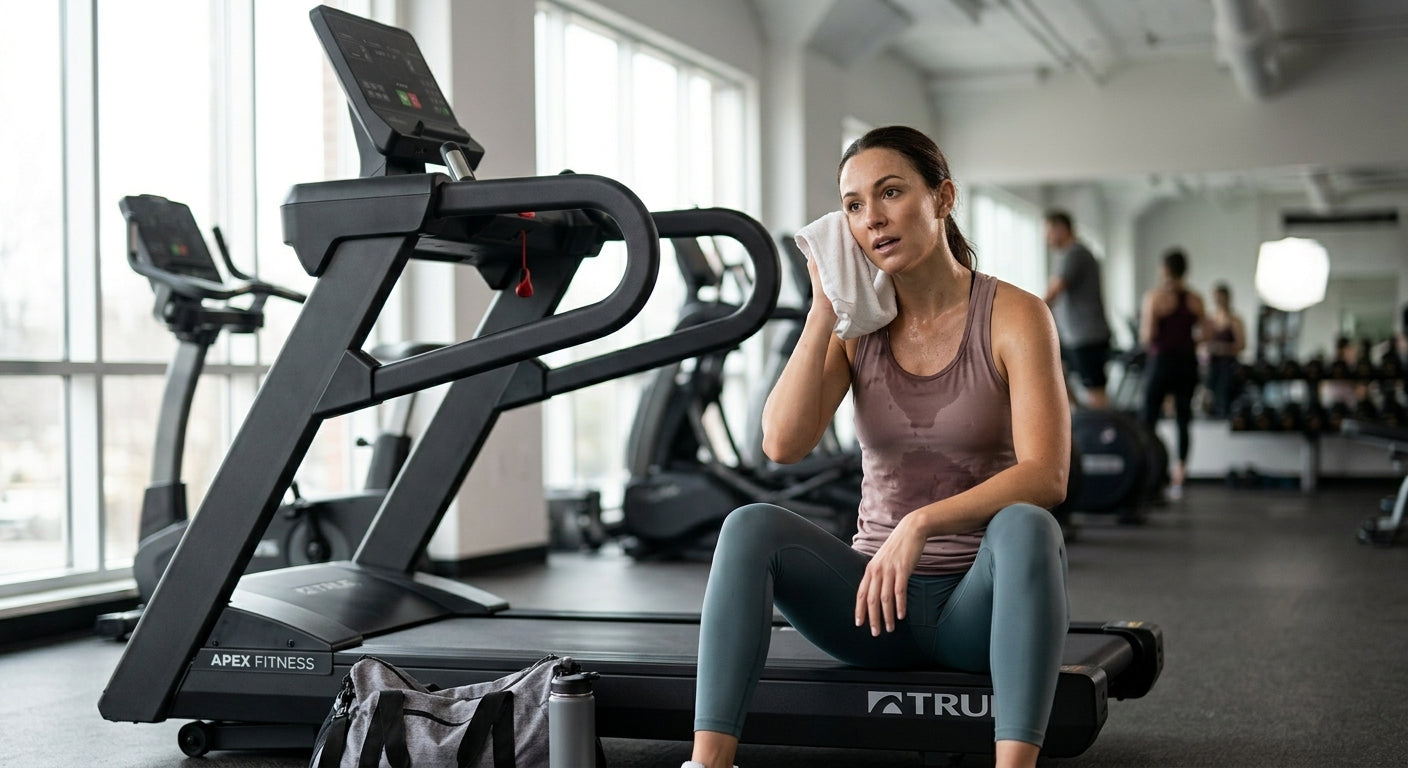
True Fitness for Commercial Facilities: Which Treadmill Fits Your Gym?
If you've been in this industry as long as I have, you learn pretty quickly that a treadmill spec sheet only tells half the story. I've watched plenty of gym owners fall in love with a shiny touchscreen console, sign the invoice, and then call six months later wondering why the belt is stretching or the motor is running hot by 10 a.m. True Fitness has built its reputation over more than three decades by avoiding that outcome, and it's part of why the brand shows up so often on the floor of serious commercial facilities from big-box clubs to boutique studios to hotel fitness centers. But "True Fitness" isn't a single product. It's a lineup, and the treadmill that's right for a 24-hour strength gym is not necessarily the one you want in a hotel amenity space. This guide walks through what actually separates these machines, so you can match the right True treadmill to the traffic your facility sees.
What "Commercial-Grade" Actually Means on a Treadmill
Every manufacturer slaps the word "commercial" on its marketing copy, so it's worth being specific about what it means when it's true. On a treadmill, commercial-grade construction usually comes down to three things: the frame, the motor, and the way the deck and belt are engineered to shed heat and resist wear under near-continuous use. True builds its commercial and light-commercial frames from robotically welded, heavy-gauge steel, which matters more than it sounds like it should. A frame that flexes even slightly under repeated impact loosens bolts, misaligns belts, and shortens the life of every other component around it. True also uses its own TRUE Soft System or TRUE FITX cushioning depending on the model, engineered to absorb impact without turning mushy the way other systems do after a few thousand miles of use.
The other piece people underestimate is the deck and belt combination. A gym that runs a treadmill eight, ten, or sixteen hours a day needs a belt that resists stretching and a deck surface that doesn't need constant lubrication and adjustment, because every hour a machine is down for maintenance is an hour a member is annoyed at your front desk. This is where True's higher-tier commercial machines, particularly the Vapor Series, separate themselves from home and light-commercial units with reversible, low-maintenance belts and decks built specifically for facilities that don't get a day off.

Motor Power and Duty Rating: The Number That Actually Predicts Longevity
If you only look at one spec before buying a commercial treadmill, make it the motor. Horsepower numbers get thrown around loosely in this industry, and "peak horsepower" claims on cheap machines are close to meaningless. What you want is continuous horsepower (CHP), which measures sustained output rather than a brief spike. A motor that's undersized for your traffic will run hotter, wear out its bearings faster, and eventually fail at the worst possible time.
Across the True lineup, motor output scales with how much traffic the machine is designed to absorb. The True Fitness Launch Treadmill runs a 3.0 HP DC continuous-duty motor, which is plenty for boutique studios, corporate wellness rooms, or hotel gyms with moderate, spread-out use throughout the day. Step up to the True Fitness Performance Series PS 8000 or the True Fitness Gravity Treadmill, both running 4.0 CHP motors, and you get meaningfully more headroom for facilities where the treadmill rarely sits idle. For high-traffic environments a strength and conditioning gym, a large commercial club floor, or a 24-hour facility where the machine might see back-to-back users for hours at a stretch. I steer owners toward the Vapor Series. The True Fitness Vapor Series Stryker Slat Treadmill is built around a commercial-grade motorized drive system paired with a double-braking system and a 62-slat vulcanized rubber running surface rather than a traditional belt, which essentially eliminates belt stretch and slippage even under heavy, repeated use.
It's also worth paying attention to top speed and incline range if your programming leans toward performance training or HIIT-style classes. The Stryker Slat hits speeds up to 12.5 mph with incline up to 25% (and an optional decline kit that brings it to -3%), which is a different than a walking-focused treadmill topping out at 12 mph and 15% incline. If your gym runs sled-style incline work or sprint intervals, that range is the difference between a machine that can keep up with your class programming and one that can't.
Warranty Coverage: Read the Commercial Tier, Not the Home Tier
This is where a lot of buyers get tripped up, because many manufacturer spec sheets list warranty terms for both in-home use and commercial use, and those numbers can look very different. A treadmill advertised with a 12-year frame warranty for home use might carry a 7-year frame warranty once you register it for commercial deployment, because the manufacturer knows a machine running club hours accumulates wear at a completely different rate than one in someone's basement.
The good news is that True is transparent about this, and its commercial-tier machines are engineered and warrantied accordingly from the start. The Vapor Series Alpine Runner and Stryker Slat both carry commercial warranty coverage of 7 years on the frame, 3 years on parts and console, and 2 years on labor, with a limited-use commercial tier available on the Alpine Runner that extends parts and belt coverage to 5 years for facilities with lighter but still commercial-level traffic. Compare that to the Performance Series and Launch models, which are built to a high standard but are warrantied primarily for in-home or light-commercial use, still a fit for a boutique studio or a low-traffic hotel gym, but not the machine you want anchoring the cardio wall at a high-volume club. Before you commit to any model for a commercial installation, ask directly what the commercial warranty terms are versus the residential terms, and get it in writing. It's the single easiest way to avoid a surprise a year or two down the road.

Matching the Right Model to Your Facility's Traffic
Here's how I'd actually break this down for an owner or facility manager sitting across the desk from me. If you're outfitting a low-traffic amenity space, a small apartment complex gym, a break room, or an area that sees a handful of users a day, the True Fitness Z500 is a capable, well-built entry point, but I wouldn't put it on a busy commercial floor; it's simply not engineered for that duty cycle. For boutique studios, hotel fitness centers, and corporate wellness rooms with moderate, spread-throughout-the-day use, the Performance Series PS 3000, PS 8000, and the Launch treadmill all deliver commercial-grade cushioning and control on frames that are built to last, at a price point that makes sense for a smaller footprint.
Once you're talking about a real commercial gym floor, steady foot traffic from open to close, members who expect zero downtime, and a facility where a broken treadmill directly costs you member satisfaction and revenue, that's where the Gravity and the Vapor Series machines earn their keep. The Gravity treadmill splits the difference nicely for mid-size clubs and studios that want a more substantial machine without stepping all the way up to Vapor Series pricing. For anything approaching high-traffic, 24-hour, or performance-training use, the Alpine Runner and Stryker Slat are the two models actually engineered and warrantied for that job. The Alpine Runner is worth a close look if incline and hill training are central to your programming, it's purpose-built for climbing work with a lower step-up option available, which matters when you've got members cycling on and off quickly during a class. The Stryker Slat is the machine I point people to when they want the closest thing to a bulletproof cardio floor: the slat-belt design alone tells you it was engineered for facilities that don't get downtime, and it shows in both the spec sheet and the commercial warranty backing it.
A few bullet points worth keeping in front of you while you compare models:
- Match motor CHP to your busiest hour, not your average hour — a facility that's quiet most of the day but slammed from 5 to 7 p.m. still needs a motor rated for that peak load.
- Confirm commercial warranty terms specifically, not just the headline number on the spec sheet.
- Consider deck and belt type (traditional belt vs. slat) if your programming includes heavy incline, sprint, or interval work.
- Factor in console durability and touchscreen size for member-facing units versus back-of-house or staff-only machines.
Delivery, Setup, and Regional Considerations
Where your facility sits geographically actually plays a small but real role in equipment planning. We work with gym owners and facility managers across Sacramento and Rancho Cordova, where Central Valley heat and dust can accelerate wear on ventilation components and console electronics if a facility isn't climate-controlled consistently, and with clubs throughout the Tacoma and Seattle area, where higher humidity levels make belt and deck maintenance schedules worth double-checking against manufacturer guidance. None of this changes which True model is right for your traffic volume, but it's a good reason to have a real conversation with your equipment provider about delivery, professional assembly, and ongoing service support in your specific market rather than just clicking "buy" on a spec sheet.
Console Features and the Member Experience
Durability gets a facility through the day, but the console is what your members actually interact with, and it shapes how a piece of equipment gets used and reviewed. True's commercial and light-commercial lines share a family of consoles. From the simple Unite LED up through 16" and 22" touchscreen options with Bluetooth connectivity, contact and Polar wireless heart rate monitoring, and app integration through the GymTrakr platform on select models. For a member-facing cardio floor, I generally recommend springing for the larger touchscreen options; members increasingly expect the kind of interface they're used to on their phones, and a dated console can make an otherwise excellent treadmill feel tired long before the mechanical components actually wear out. For staff areas or lower-visibility spaces, the LED or smaller display options save budget without sacrificing the durability that matters most in those settings.
Total Cost of Ownership Beyond the Sticker Price
One last thing worth saying plainly, because I think about it every time a facility manager asks me to help them budget: the purchase price is only part of the equation. A less expensive treadmill that needs belt replacements every year, or that goes down for a week waiting on a part, costs more over five years than a properly specified commercial machine that just runs. Factor in parts availability, local service support, and how quickly a manufacturer can get a technician on-site, in addition to the frame and motor specs. True has built a strong reputation on the service side of that equation, which is part of why so many facility managers who've been burned by cheaper commercial brands end up back at True for their next equipment cycle.
Choosing the right treadmill for a commercial facility isn't about finding the single "best" machine, it's about being honest with yourself about your traffic patterns, your programming, and your budget, and then matching that reality to a model that's actually engineered for it. Whether that ends up being a Performance Series treadmill for a boutique studio or a Vapor Series Stryker Slat for a high-volume club floor, getting that match right up front is what keeps your cardio wall running and your members happy.
Share:
Wellness Trends 2026: What's Actually Worth Adding to Your Home Gym