

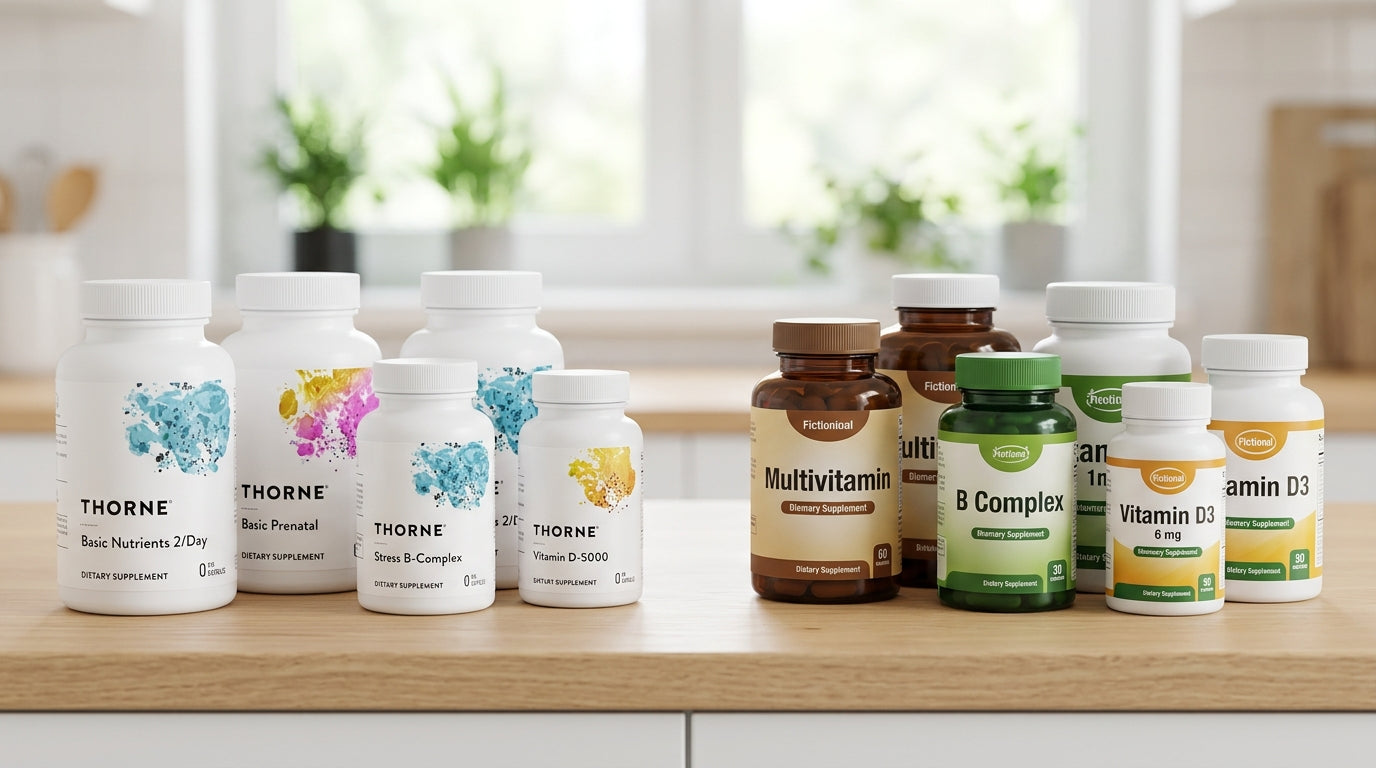
Thorne vs Generic Supplements: Is the Quality Difference Worth It?
If you've stood in a supplement aisle or scrolled through one online, staring at two bottles of "the same" creatine or whey protein isolate with a $20 price gap between them, you've probably asked yourself the same question "is the expensive one actually better, or is it just better marketing?" After more than three decades of fitting out home gyms, commercial facilities, and serious training programs, we've had a front-row seat to how that question plays out in real life, and it's rarely as simple as "you get what you pay for." Sometimes generic really is fine. Sometimes it isn't even close. The difference almost always comes down to what happens before the product ever reaches the shelf, how it's tested, who's checking it, and whether the label can actually be trusted.
This isn't a knock on every budget supplement on the market. Plenty of inexpensive products are made responsibly by companies that simply don't chase the certifications that cost real money to earn. But when you're training seriously, competing, or just tired of wondering whether what's in the tub matches what's on the label, the quality conversation stops being academic. It starts affecting your results, your health, and in some cases, your eligibility to compete at all. That's the conversation we want to have here.
Why This Comparison Actually Matters
The supplement industry in the United States operates under a regulatory structure that's a lot looser than most people assume. The FDA classifies supplements as food, not drugs, which means products don't need pre-market approval the way medications do. A manufacturer can bring a product to market, and unless something goes seriously wrong, nobody outside the company is required to verify that what's printed on the label matches what's actually in the capsule or the scoop. Studies analyzing supplements pulled off store shelves have repeatedly found significant gaps between label claims and lab results. Sometimes underdosed active ingredients, sometimes contaminants that were never disclosed, and occasionally banned substances that had no business being there in the first place.
That regulatory gap is exactly where the "Thorne vs generic supplements" question gets interesting. It's not really a brand-loyalty debate. It's a question about verification: does an independent third party confirm what's in this product, or are you simply trusting the manufacturer's word? For a weekend lifter who just wants a decent multivitamin, that gap might not matter much. For a competitive athlete, a coach responsible for a roster of athletes, or someone managing a health condition where dosage accuracy actually matters, it can be the whole ballgame.
What "Generic" Actually Means Here
We should be clear about terminology, because "generic" gets used loosely. We're not necessarily talking about store-brand products (though plenty fall into this category). We mean any supplement regardless of price point that hasn't gone through independent, third-party verification of its contents. Some of these products are made in the same manufacturing facilities as premium brands and are perfectly clean. Others are made more cheaply, with less rigorous sourcing, less quality control between batches, and no outside party checking the finished product against the label.
The problem is that from the outside, sitting on a shelf or a webpage, you cannot tell the difference. Two bottles of "creatine monohydrate" can look identical and be manufactured to completely different standards. That's the core issue certification programs are designed to solve, they replace "trust us" with documentation you can actually verify.

NSF Certified for Sport: What It Actually Tests For
This is where Thorne's approach diverges from most of the market. A large portion of Thorne's product line holds NSF Certified for Sport® certification. That's not a marketing badge a company can slap on a label after a quick internal review. NSF International is an independent, accredited organization that audits manufacturing facilities, reviews every ingredient in a formula, and tests finished products in a lab before certification is granted. And then continues testing batches after the fact to make sure standards hold up over time.
Specifically, NSF Certified for Sport testing confirms three things. First, that the product contains what the label says it contains, in the amounts stated, no more, no less. Second, that the product is free of nearly 300 substances banned by major athletic organizations, including the NCAA, MLB, NFL, NHL, and the International Olympic Committee. Third, the manufacturing facility itself meets good manufacturing practice (GMP) standards, meaning the environment where the product is made is regularly inspected and audited. Thorne Creatine (90 servings) and Whey Protein Isolate both carry this certification, and honestly, it's the reason we're comfortable recommending them to athletes who can't afford even the appearance of a banned substance showing up on a drug test.
Third-Party Testing vs. Taking the Label's Word for It
Third-party testing is the mechanism that makes certification meaningful, and it's worth understanding what it actually looks like in practice. Instead of a company testing its own products and reporting the results (which is the honor-system approach most supplements operate under), an outside lab with no financial stake in the outcome pulls samples and runs them through analytical testing. Checking for label accuracy, screening for heavy metals and microbial contamination, and confirming the absence of banned or undisclosed substances. Because the lab doesn't answer to the supplement company, there's no incentive to look the other way on a failed batch.
This matters more than people initially assume, and not just for athletes worried about drug testing. Contamination issues in the supplement industry have shown up in products ranging from protein powders to pre-workouts to joint-support formulas, sometimes involving heavy metals like lead or arsenic at levels that wouldn't be caught without dedicated lab analysis. A company that invests in ongoing third-party testing is, in effect, telling you they're willing to have their homework checked by someone with no reason to grade generously. A company that skips it might be making a perfectly good product, or might not be. You just don't have the documentation either way.
Where the Difference Shows Up in Actual Training
Set aside certification for a moment and think about what quality actually does for you day to day. Bioavailability, how much of an ingredient your body can actually absorb and use, varies enormously between formulations, even when the label lists the same dose. A magnesium supplement using a poorly absorbed form might list an impressive number on the bottle while delivering a fraction of that to your bloodstream. Thorne tends to favor more bioavailable ingredient forms across its line, which is part of why the Basic Nutrients 2/Day multivitamin uses forms like zinc bisglycinate and vitamins K1/K2 rather than the cheaper, less absorbable versions you'll often find in bargain multivitamins.
For serious training, this shows up in recovery quality, consistency of energy levels, and frankly whether you notice the supplement doing anything at all. Athletes who switch from an unverified pre-workout or amino product to something like Thorne's Amino Complex often report more consistent effects, which usually isn't placebo, it's the difference between a formula that was dosed accurately and one that was formulated to look good on a label at the lowest possible cost. Hydration and electrolyte balance is another area where this plays out; our Daily Electrolytes line is a good example of a category where dosing accuracy on sodium and potassium actually matters for how you perform in a long session, not just how the product tastes.
Inflammation management is a similar story. Thorne's Curcumin Phytosome uses a phytosome delivery technology specifically because standard curcumin is notoriously poorly absorbed on its own. A generic curcumin capsule might contain the same milligram amount and still deliver far less into your system. This is the piece that's easy to miss when comparing two products purely on their label numbers: the raw dose only tells part of the story.
Doing the Cost-Per-Serving Math Honestly
We'd be doing you a disservice if we pretended the price gap doesn't exist, so let's talk about it directly. Certified, third-party-tested supplements generally do cost more, and there are real reasons why: the certification process itself isn't free, batch testing is an ongoing expense rather than a one-time cost, and higher-bioavailability ingredient forms typically cost more to source than their cheaper counterparts. None of that is manufactured markup — it's the actual cost of doing what it claims to do.
That said, cost-per-serving is where the math sometimes surprises people. A $44 tub of creatine that delivers 90 accurately-dosed servings works out to roughly 49 cents per serving, not far off from many "budget" options once you account for serving size and concentration, and considerably cheaper than replacing a product that turns out to be underdosed or contaminated. The premium isn't always as large as the sticker price suggests once you run the actual per-use numbers, and for a handful of categories. Creatine monohydrate being the clearest example, the ingredient itself is so well-studied and inexpensive to produce properly that certified versions aren't dramatically pricier than reputable uncertified ones.
Who Actually Needs the Higher Bar
Not everyone needs to pay for certification, and we'll say that plainly even though we sell certified products. If you're a general fitness enthusiast taking a basic vitamin D or a protein shake after casual workouts, a reputable but uncertified brand from a company with a good manufacturing track record is probably fine. Where the calculation changes is for anyone subject to drug testing - high school and college athletes, military personnel, law enforcement candidates, or competitive amateurs and professionals in any tested sport. For that group, an uncertified product isn't just a quality question, it's a real risk, since supplements have been the source of more than a few unintentional positive tests over the years.
It also matters more for anyone managing a specific health goal where dosage precision counts. Someone tracking iron levels, managing a diagnosed deficiency, or working with a physician or dietitian on a targeted protocol. And it matters for anyone who trains hard enough, frequently enough, that supplement quality compounds over months and years rather than being a one-off purchase.
Our Take After Fitting Out Gyms for 30-Plus Years
We've outfitted training spaces from serious home setups here in the Sacramento and Rancho Cordova area to commercial facilities up toward the Tacoma and Seattle region, and one pattern holds true regardless of geography or budget: the people who train the longest and stay healthiest tend to be the ones who get particular about the details other people skip. That includes equipment maintenance, programming, recovery, and yes, what they're actually putting in their bodies. We don't think every product on our shelves needs to carry NSF certification to be worth selling, but for the categories where verification changes the outcome — protein, creatine, multivitamins, and anything an athlete might be tested for, we've found it's worth the extra cost, and it's why Thorne leans so heavily on certified formulas.
The Bottom Line
The Thorne vs. generic supplements debate isn't really about brand snobbery. It's about whether you want documentation behind what you're taking or you're comfortable trusting a label with no outside verification. For casual training, that trust might be a reasonable bet. For anything more serious, competition, drug testing, a health condition, or simply years of consistent training where small advantages compound, paying for independent testing and higher-bioavailability formulas tends to be one of the more defensible upgrades you can make to a training program. As always, the right call depends on your specific goals, budget, and what you're actually training for, and we're happy to help you figure out where on that spectrum you land.


Share:
Pickleball Training Equipment: Play Your Best