


Building a home gym is exciting. There is something satisfying about carving out a space that is entirely yours. The equipment fits your goals. The layout reflects your style. The time you save driving to a gym starts adding up quickly.
But after a year or two, something shifts.
Maybe your workouts feel repetitive. Maybe you have progressed beyond your original setup. Or maybe your space works, but it no longer inspires you the way it once did.
The good news? Upgrading your home gym does not mean tearing it down and starting from scratch.
In 2026, smart homeowners are upgrading strategically. Instead of replacing everything, they are layering in versatility, performance, and smarter layout decisions to make their existing space feel new again. At The Fitness Outlet, we help customers evolve their home gyms in phases. Here is how to do it intentionally.

1. Add Versatility Instead of Replacing Equipment
One of the biggest mistakes people make when planning a home gym upgrade is assuming they need a complete overhaul. In most cases, what they actually need is more variety.
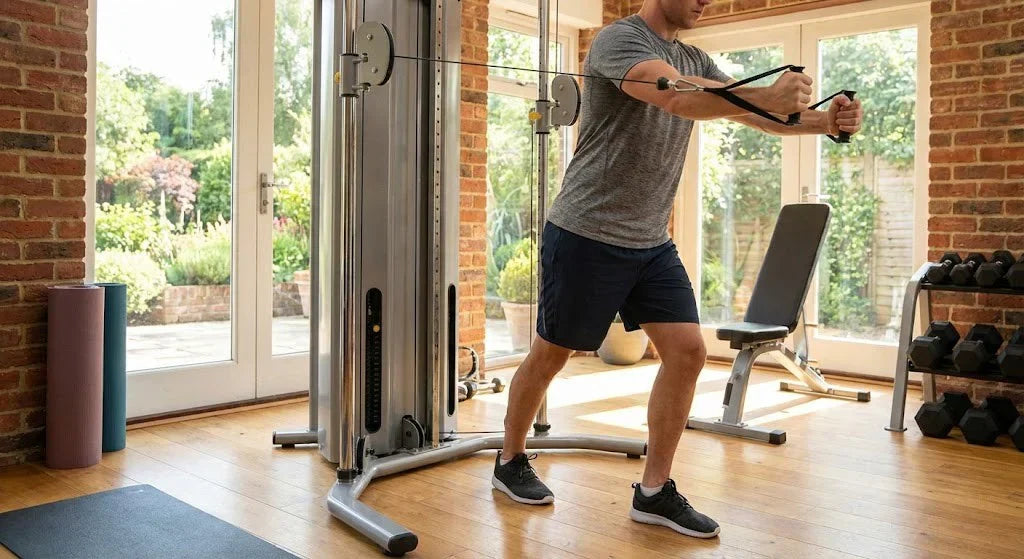
If you already own a treadmill or bike, consider adding a strength piece that expands your training options. A functional trainer is one of the most impactful upgrades you can make because it replaces the need for multiple single-purpose machines in a single compact footprint.
The Hoist Mi5 Functional Trainer is a strong choice for most home setups. Its independently adjustable cable columns let you train pressing, pulling, rotation, and core work from virtually any angle. If you want more room to grow, the Hoist Mi7 Functional Training System adds a larger weight stack and greater versatility for athletic conditioning and multi-user households.
If your setup already leans toward free weights and a bench, a guided strength system like the Body-Solid G6BR Bi-Angular Home Gym adds structured movement patterns that complement your existing equipment rather than competing with it.
Strategic additions create growth without waste.
2. Upgrade Your Cardio Experience
Cardio equipment often sees the most use in a home gym, which means it also shows its age the fastest. Over time, entry-level machines can start to feel limiting, not just in features, but in the feel of every stride or pedal stroke.
Upgrading your cardio does not always mean going bigger. It means going better.
The Spirit XT685 Treadmill is a good example of what that looks like in practice. It runs quieter than most residential machines, uses a powerful motor built for consistent daily use, and offers a spacious running surface that feels closer to what you would find in a commercial gym. For cyclists and low-impact training, the Keiser M3i Indoor Bike with Bluetooth delivers an exceptionally smooth magnetic resistance ride with real-time performance data you can sync to your favorite fitness apps.
Homeowners who upgrade cardio equipment consistently notice the difference immediately. Less noise, better cushioning, more intuitive controls, and a machine that simply feels like it will last. If your current machine has become something you tolerate rather than enjoy, this upgrade tends to deliver the most noticeable day-one improvement.
3. Improve Layout and Flow
Sometimes the issue is not the equipment at all. It is the layout.
A cluttered or poorly organized space can make even premium equipment feel cramped and uninviting. Before spending anything, it is worth walking through your gym and asking whether the arrangement actually supports how you train. Can you move freely between stations? Is there a clear path from your warm-up area to your strength equipment? Does the space feel like a place you want to spend time in?
Rearranging your setup to create defined training zones, a cardio area, a strength area, and open floor space for mobility or stretching, can instantly change how your gym feels without spending a dollar on new equipment.
From there, targeted additions can have an outsized impact. Quality rubber flooring reduces noise, protects your subfloor, and makes the space feel finished rather than improvised. A wall-mounted weight storage system clears floor space and keeps the room looking clean and organized. Better lighting, even something as simple as adding a floor lamp or switching to brighter bulbs, can make a low-ceiling basement gym feel more open and energizing.
A quality adjustable bench like the Hoist Fitness Folding Multi-Position Bench adds a versatile surface for pressing, step work, and stretching while folding flat when not in use, which is a meaningful advantage in smaller spaces.
Good layout makes every piece of equipment you already own easier and more enjoyable to use. It is often the most underrated part of a home gym upgrade.
4. Add One Premium Piece That Elevates the Entire Space
If you want your home gym to feel upgraded immediately, sometimes one well-chosen addition is all it takes.
A vibration training platform like the Power Plate Pro8 adds a recovery and performance tool used in professional and clinical settings. It improves circulation, accelerates warm-up, and supports muscle activation in ways that complement almost any training style. A commercial-grade cardio machine or selectorized strength station can introduce a level of smoothness and durability that resets the standard of everything around it.
The goal is not to overcrowd the room. It is to introduce something that expands capability and raises the overall feel of the space. Many homeowners in 2026 are choosing light commercial gym equipment for their private setups precisely because it offers that premium experience without the footprint of a full health club.
One intentional addition can shift your entire training experience.
5. Plan for the Next Phase of Your Gym
A home gym is not a one-time purchase. It is a space that should evolve as your training evolves.
When you make an upgrade, it is worth thinking one step ahead. If you add a functional trainer now, will you want a dedicated squat rack in two years? If you upgrade your treadmill, is there space to eventually add a rowing machine alongside it? Planning with even a loose sense of where your gym is headed helps you avoid layouts or purchases that will need to be undone later.
At The Fitness Outlet, we often encourage customers to sketch out a longer-term vision before committing to any single upgrade. That way, each addition builds toward something rather than simply filling available space. A little foresight now saves a lot of rearranging later.
Signs It Is Time to Upgrade Your Home Gym
If you are on the fence, a few patterns tend to indicate your setup has outgrown your training. Your workouts feel repetitive and you find yourself cycling through the same movements by default. You have exceeded the weight capacity of your current equipment. You avoid certain exercises because your setup simply does not support them. Your cardio machine has become louder or less stable than it used to be. Or a second household member has started sharing the space and the layout no longer works for two people.
Upgrading is not about chasing trends. It is about matching your equipment to where your training actually is right now.
Upgrading Without Overspending
A well-designed home gym does not need to be rebuilt all at once. Prioritizing upgrades by impact, versatility first, then comfort, then long-term durability, keeps costs manageable while steadily improving your space.
To put that in concrete terms: a mid-tier functional trainer in the $2,000 to $3,500 range can effectively replace a cable machine, a chest fly station, and a lat pulldown in a single footprint. That kind of consolidation often saves money compared to buying those pieces separately while freeing up significant floor space in the process.
Buying light commercial equipment rather than residential-grade gear can also be a smarter long-term investment. The upfront cost is higher, but the equipment lasts longer, performs better under daily use, and retains more of its value if you ever decide to sell.
At The Fitness Outlet, we evaluate ceiling height, square footage, training goals, and long-term usage before recommending any upgrade. The right addition should feel intentional, something that earns its place in the room every time you train.

Share:
Commercial-Grade Equipment at Home: Is It Worth It in 2026?
Why Great Gym Equipment Goes Unused (And How to Fix It)