

Knee pain affects millions of people, from weekend warriors dealing with old injuries to older adults managing arthritis. But here's what most people get wrong: resting your knees isn't the answer - training smarter is.
The right equipment lets you stay active, build strength, burn calories, and protect your joints at the same time. The wrong equipment - or pushing through the wrong exercises - can set you back weeks. That's why choosing the right machine matters as much as how often you use it.
This guide covers the best exercise machines for bad knees, what to look for, what to avoid, how to get started safely, and the specific products we recommend at The Fitness Outlet.
Why Exercise Actually Helps Bad Knees
It sounds counterintuitive, but movement is medicine for knee pain. Strengthening the muscles around your knee - your quads, hamstrings, and glutes - takes pressure off the joint itself. When those muscles are weak, the knee absorbs forces it was never designed to handle alone. Building them back up is one of the most effective long-term strategies for reducing pain and preventing further damage.
Common causes of knee pain include:
- Osteoarthritis - cartilage breakdown that causes bone-on-bone friction
- Runner's Knee (Patellofemoral Syndrome) - irritation of the kneecap from repetitive movement
- ACL or Meniscus Injuries - past injuries that leave the knee less stable
- General wear and tear - years of high-impact activity adding up
In each case, low-impact exercise that keeps the knee moving through a controlled range of motion is typically recommended by physical therapists as part of recovery and ongoing management. The goal isn't to avoid using your knee - it's to use it wisely.
What Makes Exercise Equipment "Knee-Friendly"?
Not all machines are created equal. Knee-friendly equipment should:
- Eliminate or minimize impact - no hard landings or pounding on joints
- Support a natural range of motion - so your knee tracks correctly without overloading
- Distribute load properly - engaging hips and glutes to share the work
- Be adjustable - so you can customize the fit to your body and limitations
Fit matters more than most people realize. A seat that's too far forward or pedals at the wrong angle can turn a low-impact machine into a source of knee irritation. When in doubt, take the time to dial in your setup before you start pushing intensity.
The Best Exercise Equipment for Bad Knees
1. Recumbent Bikes - The Gold Standard for Knee Rehab
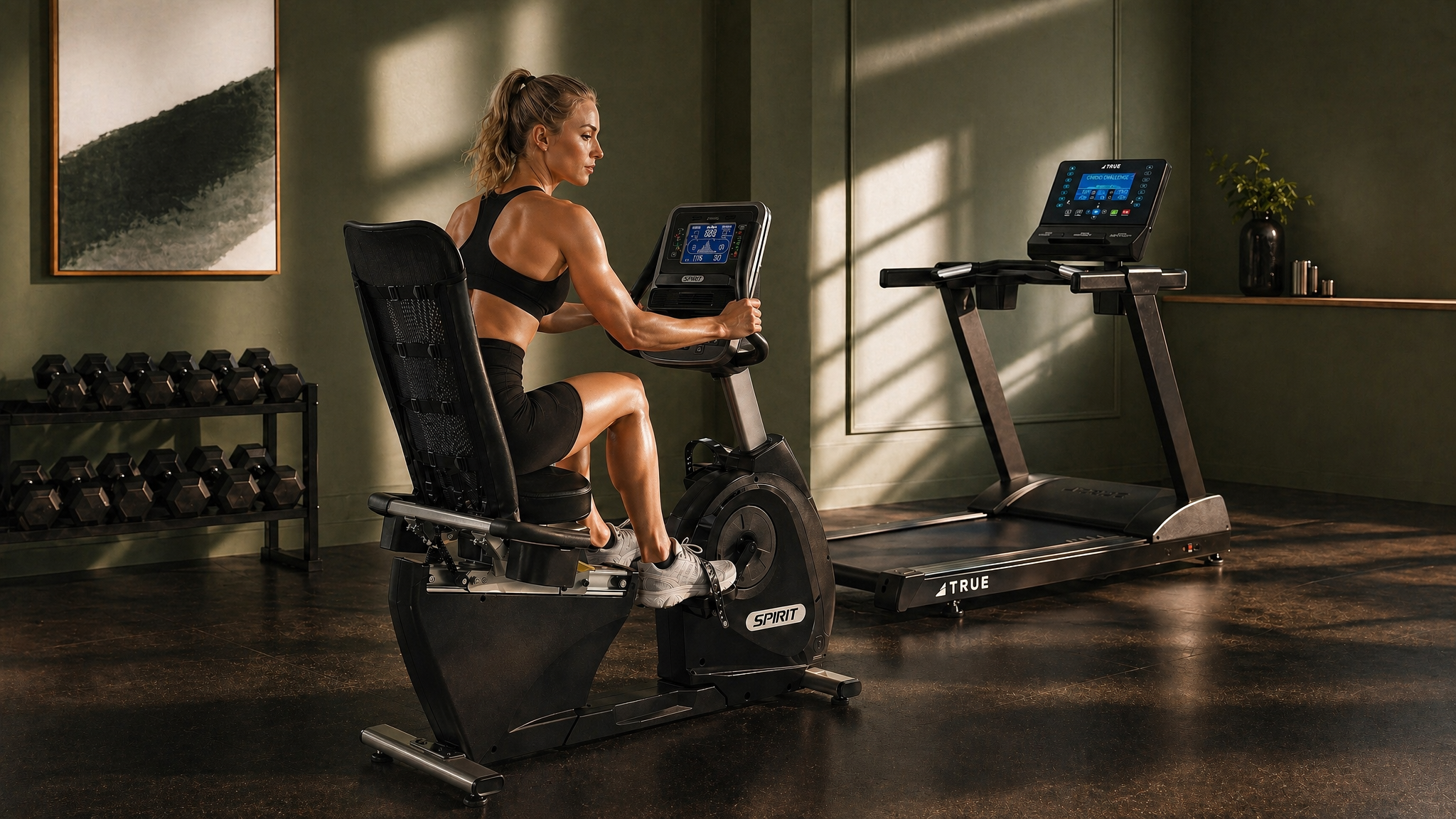
If there's one machine physical therapists recommend most for knee pain, it's the recumbent bike. Your weight is fully supported, your back is cushioned, and your legs pedal in a smooth circular motion that lubricates the knee joint without loading it. Recumbent bikes feature in almost every knee rehab protocol - from post-surgery recovery to long-term arthritis management.
What sets a recumbent bike apart from an upright bike is the position of the pedals. They sit out in front of you rather than directly below, which reduces the bend angle at the knee and makes the movement far more comfortable for people with pain or limited range of motion. The back support also takes stress off the lower back, which is commonly affected when people compensate for knee pain during other activities.
Spirit Fitness XBR55 Recumbent Bike - Our most popular recumbent model. Commercial-grade frame, 24 lb flywheel, 20 resistance levels, reclining mesh seat, step-through design, and Bluetooth app connectivity. An excellent all-rounder at a strong price.
Life Fitness RS1 Recumbent Bike - Modeled after the world's best-selling commercial Lifecycle bikes. Open step-through frame, self-balancing pedals, deluxe cushioned seat, and choice of self-powered or connected console. The pick if you want club-quality engineering at home.

2. Ellipticals - Low Impact, Full Body Cardio
Ellipticals mimic running - same muscles, same motion - but your feet never leave the pedals, so there's zero impact on your knees. The moving handlebars also engage your upper body, making ellipticals one of the most time-efficient low-impact workouts available.
One thing that makes ellipticals particularly useful for knee pain sufferers is the ability to adjust stride length and pedal angle. A longer stride engages the glutes more, while a shorter stride focuses on the quads. Pedal tilt adjustments allow you to find the angle that feels most natural for your knee tracking, reducing the likelihood of irritation over longer sessions. Many people who can't run comfortably find they can do 30-45 minutes on an elliptical with no issues at all.
Spirit Fitness XE295 Elliptical - A 20" stride, 3-position adjustable pedals, and dual aluminum rails deliver biomechanically sound, joint-friendly movement. The adjustable pedals are a standout feature for knee pain sufferers - proper foot alignment significantly reduces kneecap stress.
BodyCraft E1000 Elliptical - Built to commercial standards, the E1000 mirrors your natural gait with a whisper-quiet generator brake system, 30 resistance levels, and a 23" stride. Exceptionally smooth and genuinely easy on the joints.
3. Seated Ellipticals - Maximum Joint Protection
For those who need even less joint stress than a standing elliptical, a seated elliptical delivers the same full-body motion from a fully supported position. Particularly popular in rehab settings, with seniors, and anyone recovering from knee surgery.
The key advantage over a standard recumbent bike is that you get upper body engagement too, which increases calorie burn and cardiovascular benefit without asking more of your knees. If you've found recumbent bikes a little too easy but standing ellipticals uncomfortable, a seated elliptical is often the perfect middle ground.
Octane xR6x Seated Elliptical - Built on a commercial platform with PowerStroke technology, the xR6x delivers significantly more glute activation than a standard recumbent bike. Fully adjustable seat, step-through access, forward and reverse pedaling, and multi-position handlebars for upper body engagement. One of the best seated cardio machines available.
4. Pendulum Squat Machines - Knee-Safe Leg Strength
Cardio alone won't fix your knees long-term. You need to strengthen the muscles around the joint - but most leg machines load the knee directly. Leg presses, hack squats, and leg extensions all put significant force through the kneecap. A pendulum squat is the exception.
The key difference is in how the resistance is applied. Rather than pushing weight directly into the knee, a pendulum squat uses a swinging arc motion that distributes the load toward the hips and glutes. This lets you build serious quad and glute strength - the muscles that stabilize and protect the knee - without the compression that causes pain.
True Fitness PLS1400 Pendulum Squat - The pendulum-style movement guides your motion through a natural arc, keeping your knees in a safe position while back-loaded weight plates shift resistance toward your hips, not your knees. Oversized non-slip platform, adjustable range of motion, and dual safety catches. All the benefits of squatting with none of the knee compression.
How to Get Started Safely
Starting a new exercise routine with bad knees requires a little patience, but the payoff is worth it. Here's how to approach it:
Start low and slow. Begin with 10-15 minutes at low resistance and see how your knee responds. Some mild aching during exercise is normal; sharp or worsening pain is a signal to stop.
Warm up first. Five minutes of gentle cycling at minimal resistance before increasing intensity helps lubricate the joint and prepare the surrounding muscles.
Watch your seat position. On a recumbent bike, your knee should have a slight bend at full extension - not fully locked out and not deeply bent. On an elliptical, check that your knees aren't caving inward during the stride.
Progress gradually. Add 5 minutes or one resistance level per week, not per session. Knee pain often flares when people increase too quickly.
Rest when needed. Two to three sessions per week with rest days between is a sensible starting point. Your muscles and joints need time to adapt.
Always consult your doctor or physical therapist before starting a new exercise program, especially if you've had surgery or a diagnosed condition.
What to Avoid If You Have Bad Knees
Leg Extensions - direct shear force on the knee joint. Most physical therapists advise against these entirely for knee pain sufferers.
Walking Lunges - constant impact and instability, even with just bodyweight.
Deep Back Squats - heavy barbell squats significantly overload the knee joint unless you're fully healthy.
High-Impact Cardio - running on hard surfaces, jumping, and step aerobics all generate serious knee stress.
How to Choose the Right Equipment for Your Situation
| Your Situation | Best Equipment |
|---|---|
| Post-surgery rehab | Recumbent bike, Seated elliptical |
| Osteoarthritis | Recumbent bike, Elliptical |
| Runner's knee | Elliptical, Recumbent bike |
| Want to build leg strength | Pendulum squat |
| Limited mobility / seniors | Recumbent bike, Seated elliptical |
| Best value | Spirit XBR55, Spirit XE295 |
| Premium / long-term investment | Life Fitness RS1, BodyCraft E1000, Octane xR6x |
Share:
Best High-Performance Treadmill for Runners
Infrared Vs. Traditional Sauna for Home