


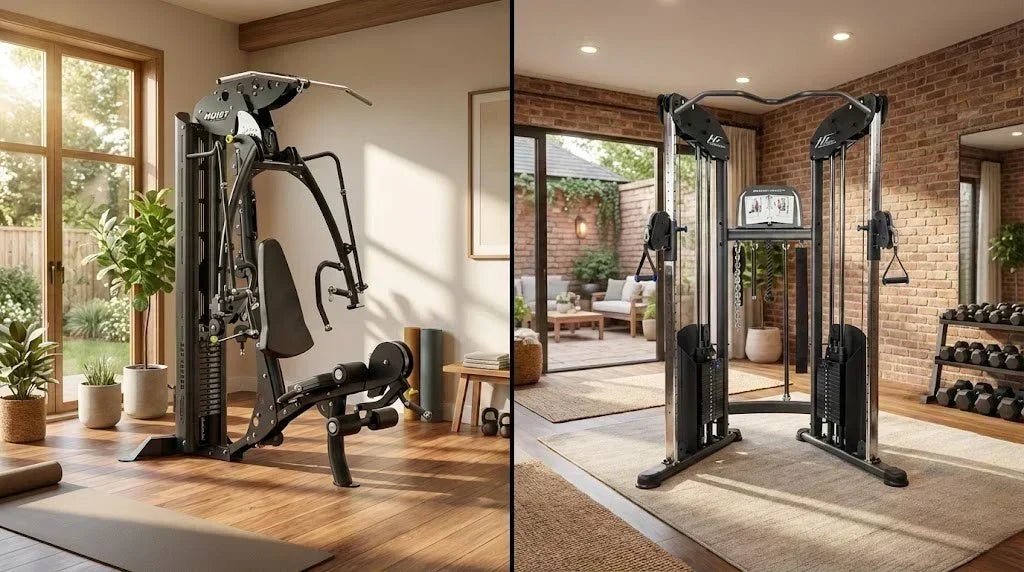
Which Should You Choose?
Choose a functional trainer if you want maximum exercise variety, cable-based movement, and room for your workouts to evolve. Choose a home gym if you prefer guided movements, simple setup, and a more structured strength-training experience. Your space, experience level, and training goals should ultimately make the decision.
Choosing between a home gym and a functional trainer is one of the most important decisions you’ll make when building a strength space at home. Both can deliver a full-body workout, but they support very different training styles, layouts, and experience levels.
Home gyms are designed around guided, structured movements. Functional trainers give you more freedom to change cable height, body position, and exercise variation.
The right choice depends less on which machine is “better” and more on how you actually want to train.
What Is a Functional Trainer?
A functional trainer is built around dual adjustable pulleys rather than fixed exercise stations. You change the height and position of the cables, which allows you to perform movements from different angles instead of following one predetermined path.
That flexibility makes functional trainers useful for traditional strength exercises, unilateral training, rotational movements, athletic work, and exercises that change as your program progresses.
Functional trainers are especially well suited for:
- Intermediate to advanced lifters
- Athletic or performance-focused training
- Users who want their workouts to evolve over time
- Anyone who prefers flexible cable-based movement
They require a little more knowledge of exercise setup and movement mechanics than a traditional home gym, but that learning curve comes with significantly more versatility.
What Is a Home Gym?
A home gym, sometimes called a multi-gym, combines several strength-training stations into one machine. Instead of choosing your own cable path, the equipment guides you through movements such as presses, pulldowns, rows, leg extensions, and curls.
Most home gyms use a selectorized weight stack and keep the major exercises within one integrated frame. That makes them straightforward to use and especially appealing to households where several people may share the same equipment.
Home gyms are a strong fit for:
- Beginners who prefer guided movement
- Families or households sharing one machine
- Users who want a predictable training experience
- Anyone prioritizing simplicity and ease of use
A home gym is often the better choice when you want one machine that replaces several traditional strength stations without requiring you to build your own workouts around cable positioning.

Functional Trainer vs Home Gym: Side-by-Side Comparison
Once you understand how each type of equipment works, the differences become much easier to compare.
| Feature | Functional Trainer | Home Gym |
|---|---|---|
| Training Style | Flexible, cable-based training | Structured, machine-guided training |
| Movement Type | Adjustable, multi-directional cables | Fixed, guided paths |
| Exercise Variety | High | Moderate |
| Ease of Use | Moderate learning curve | Simple and intuitive |
| Space | Often narrower but requires open workout space in front | Contained unit that may require more depth |
| Best Fit | Users who want variety and adaptability | Users who want guidance and simplicity |
| Long-Term Adaptability | High | Moderate |
Home Gym vs Functional Trainer: Key Factors to Consider
Think about these four factors when deciding which setup makes the most sense for your space and training goals.
1. Your Training Style
Home gyms offer guided, repeatable movement patterns. Functional trainers give you more freedom to change stance, cable height, angle, and exercise variation.
2. Available Space
Home gyms keep everything within one contained unit. Functional trainers are often narrower, but require open workout space in front of the machine.
3. Experience Level
Home gyms tend to be easier for beginners. Functional trainers offer more flexibility, but require a little more familiarity with exercise setup and movement.
4. Price & Long-Term Value
Both range widely in price. Functional trainers often offer greater exercise variety, while premium home gyms focus on guided movement, simplicity, and durability.
Maintenance & Durability
Both equipment types can provide years of residential use when purchased from reputable manufacturers.
Home gyms typically contain integrated press arms, leg stations, pulleys, and other moving components inside a fixed frame. Functional trainers rely more heavily on cable systems and adjustable pulleys.
Either design benefits from routine inspection and proper maintenance. Long-term durability depends more on the quality of the machine and manufacturer support than on whether the equipment is classified as a home gym or functional trainer.
Who Should Not Buy Each Option?
Sometimes it is easier to make the decision by identifying what does not fit the way you train.
A home gym may not be ideal if:
- You prefer dynamic or athletic-style movement
- You want maximum programming flexibility
- You regularly experiment with new strength exercises
A functional trainer may not be ideal if:
- You are completely new to strength training
- You strongly prefer guided movement paths
- Several inexperienced users will share the machine
Recommended Home Gyms & Functional Trainers
If you have narrowed down which style fits your needs, these are a few options worth considering.

HOIST Mi5 Functional Trainer
Best for: Compact spaces and shoppers who want broad cable exercise variety.
A space-efficient functional trainer with independently adjustable arms and a wide range of cable positions.
View Product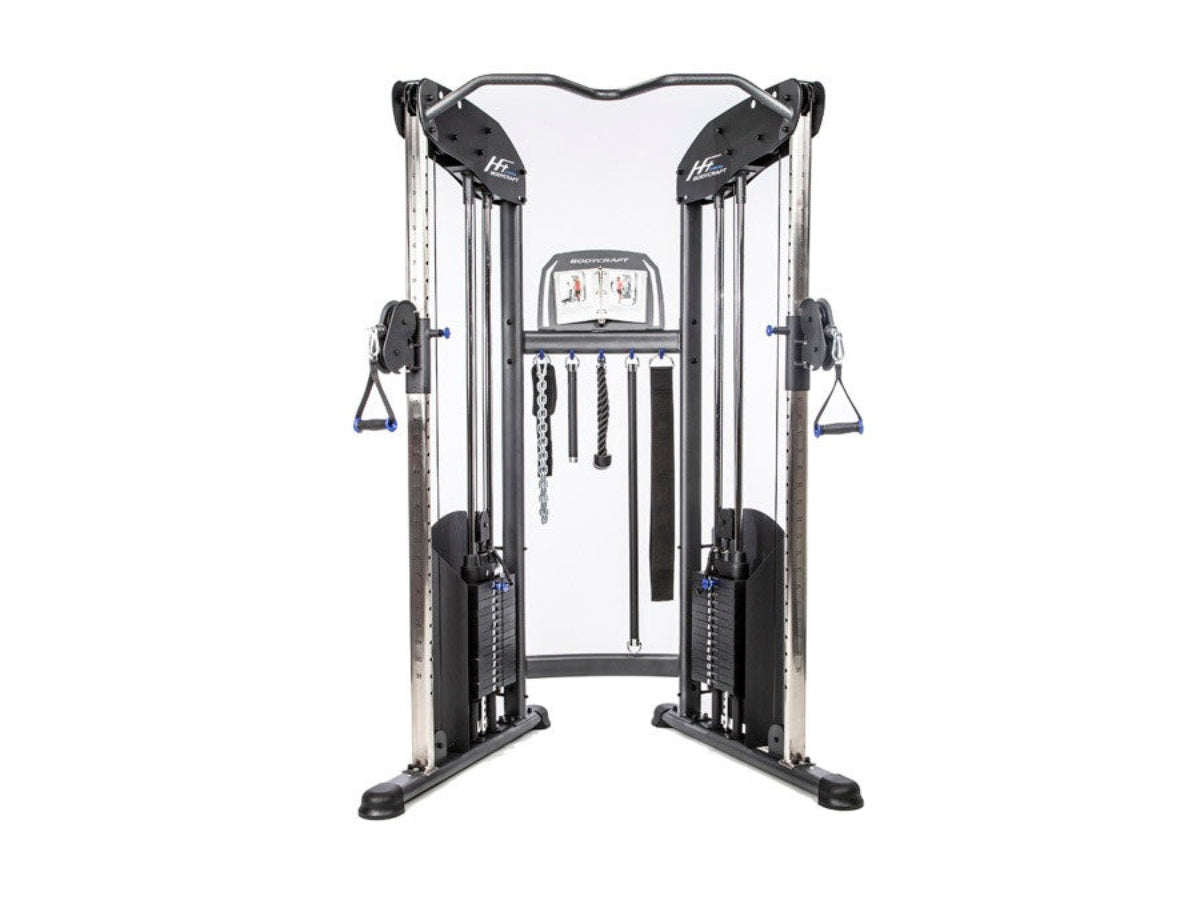
BodyCraft HFT Pro Functional Trainer
Best for: Versatile full-body cable training in a residential footprint.
Independent cable columns make it easy to adapt exercises as your training changes.
View Product
HOIST V4 Elite Home Gym
Best for: Guided full-body strength training with premium adjustability.
A premium selectorized home gym designed for smooth, structured training in one integrated system.
View Product
Body-Solid G6BR Home Gym
Best for: Multiple guided strength stations in one practical system.
A straightforward all-in-one home gym with guided upper- and lower-body training.
View ProductMeasure Your Space Before Choosing
Before purchasing a functional trainer or home gym, check more than the equipment's footprint. The clearance needed for exercises and adjustments can affect how comfortably the machine fits your room.
- Ceiling height: Confirm the machine height and any additional clearance needed for setup or attachments.
- Workout clearance: Leave room for cable movements, handles, benches, and stepping around the equipment.
- Seat and station access: Make sure users can enter, exit, and adjust the machine without hitting nearby walls or furniture.
- Delivery route: Check doorways, stairways, and access to the intended room before ordering.
Compare dimensions on the individual product pages. If you're unsure about fit, ask an Equipment Specialist before making a decision.
Functional Trainer vs Home Gym: Which Is Best in 2026?
There is no universal winner. The better option is the one that fits your experience level, available space, and the way you prefer to train.
Home gyms continue to make sense for people who want guided movement and a straightforward workout. Functional trainers are better suited to users who want greater movement freedom, exercise variety, and flexibility as their training evolves.
At The Fitness Outlet, we help customers evaluate floor space, ceiling height, training goals, and long-term plans before choosing equipment. If you are still deciding, our team can help you compare the options for your specific space.

Share:
Refreshing Your Home Gym for Spring
The Ultimate Garage Gym Setup for 2026: Build It Right From Day One