

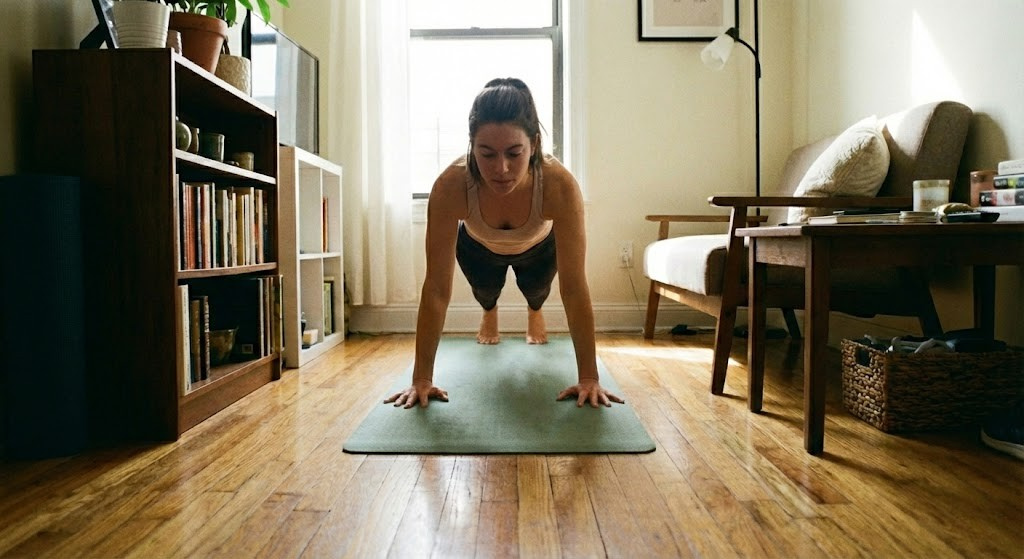
You do not need a fully equipped home gym or a large workout room to build strength. Bodyweight strength training allows you to train effectively in small spaces using movements that support real-world strength, balance, and mobility.
For many people, space is the biggest barrier to consistency. Apartments, shared living spaces, and busy schedules can make traditional workouts feel impractical. A well-structured small space workout removes those obstacles by focusing on efficient, purposeful movements that require little room and no equipment.
Bodyweight training is also highly adaptable. Whether you are new to exercise or already experienced, these workouts can be adjusted to match your current ability while still providing a meaningful challenge. In this guide, we will break down how bodyweight strength training works, which movements matter most, and how to structure beginner, intermediate, and advanced routines that fit almost anywhere.
Why Bodyweight Strength Training Works in Small Spaces
Bodyweight strength training focuses on functional movement patterns that engage multiple muscle groups at the same time. Instead of isolating muscles with machines, your body learns to move and stabilize as a connected system. This improves overall strength, coordination, and joint control.
In small spaces, this training style is especially effective. Exercises are performed mostly in place, transitions are simple, and workouts flow efficiently from one movement to the next. You do not need to rearrange equipment or dedicate an entire room to training.
Another major benefit is scalability. Intensity does not come from adding weight, but from adjusting tempo, repetitions, rest periods, and movement complexity. This allows workouts to continue evolving without needing more space or additional equipment.

The Foundation of an Effective Small Space Workout
Every effective bodyweight routine is built around a small number of foundational movements. These exercises allow you to train your entire body without needing to move far or use equipment.
Push-ups are one of the most effective upper-body exercises available. They strengthen the chest, shoulders, triceps, and core while reinforcing proper body alignment and shoulder stability.
Squats form the foundation of lower-body strength. They train the glutes, quadriceps, and hamstrings while improving hip and knee mobility. Bodyweight squats also reinforce movement patterns used in everyday life, such as standing up, sitting down, and lifting objects.
Lunges introduce single-leg training, which improves balance and coordination. Because lunges can be performed in place, they are well suited for limited spaces while helping address strength imbalances.
Planks develop core stability, which supports posture and protects the lower back. A strong core improves performance in both upper- and lower-body movements and plays a key role in injury prevention.
Together, these movements create a complete full-body workout that fits into even the smallest training area.
Beginner Bodyweight Strength Routine
This routine is designed for beginners or anyone returning to exercise after time away. The focus is on learning proper movement patterns, building confidence, and establishing consistency.
Perform two to three rounds of the following exercises:
-
Incline push-ups
-
Bodyweight squats
-
Reverse lunges
-
Forearm plank hold
Move at a controlled pace and prioritize good posture throughout each movement. Rest as needed between exercises and rounds. At this stage, consistency and form matter more than speed or intensity.
Intermediate Bodyweight Strength Routine
As strength improves, intermediate training increases difficulty through longer time under tension and shorter rest periods rather than more complex movements.
This routine should be performed for three to four rounds. It includes standard push-ups, slower tempo squats, stationary lunges, and plank shoulder taps. Focus on maintaining control through each repetition, especially as fatigue sets in.
Intermediate workouts often produce noticeable improvements in strength and endurance when performed consistently.
Advanced Bodyweight Strength Routine
Advanced bodyweight strength training challenges muscular strength, stability, and endurance while still fitting into a small space.
Perform four to five rounds of the following exercises:
-
Close-grip or decline push-ups
-
Pulse squats
-
Split squats
-
Side plank hold
These workouts should feel demanding but controlled. Maintain steady breathing and strict form throughout each set, resting briefly if technique begins to break down.
How to Structure a Short Small Space Workout
One of the biggest advantages of bodyweight training is flexibility. Even shorter workouts can be highly effective when structured with intention.
For a 20-minute workout, focus on continuous movement with minimal rest. Select four exercises and cycle through them steadily, resting only when necessary.
For a 30-minute workout, add additional rounds or slow down each repetition to increase time under tension. Longer rest periods can be used to maintain higher-quality movement.
Regardless of workout length, consistency over time is more important than session duration.
How to Progress Without Adding Equipment
Progress in bodyweight strength training comes from increasing difficulty through thoughtful adjustments rather than heavier resistance.
Effective progression methods include:
-
Slowing down each repetition
-
Increasing total repetitions or rounds
-
Reducing rest time between exercises
-
Using single-leg or single-arm variations
Tracking workouts can help measure progress and maintain motivation as strength improves.
Common Mistakes in Bodyweight Training
One common mistake is rushing through movements. Speed often reduces muscle engagement and increases the risk of poor form. Controlled repetitions deliver better results.
Another mistake is neglecting recovery. While bodyweight workouts are lower impact, muscles still need time to recover. Training too frequently without rest can stall progress.
Finally, many people underestimate bodyweight training and stop progressing too early. With proper structure, bodyweight workouts can remain challenging and effective long term.
When You Are Ready to Add Equipment
Bodyweight strength training can take you far, especially in a small space. For many people, it becomes the foundation of a long-term fitness routine. Over time, some trainees choose to add a small amount of equipment to increase variety, comfort, or progression.
This does not mean replacing bodyweight training. Instead, equipment is often used to complement it.
In small spaces, the most effective additions tend to be compact, versatile, and easy to integrate. Adjustable benches can expand exercise options without requiring much room. Functional trainers and selectorized machines allow for controlled resistance while still supporting full-body movement. Proper gym flooring also becomes more important as training frequency increases, helping protect floors, reduce noise, and improve overall comfort.
Many people begin with bodyweight workouts and gradually build out their space as goals evolve. This approach keeps training flexible and prevents overcommitting to equipment before it is truly needed.
At The Fitness Outlet, we specialize in space-conscious strength solutions designed for real homes and real training environments. Whether you stay with bodyweight training long term or decide to expand your setup, the goal remains the same: create a space that supports consistency and progress.
How Often to Train in a Small Space
Most people see excellent results training three to five times per week. Because bodyweight workouts place less stress on joints than heavy resistance training, recovery tends to be faster.
Alternating full-body workouts with lower-body or core-focused sessions can help maintain balance while reducing overuse and supporting long-term consistency.
Why Bodyweight Training Belongs in Every Fitness Plan
Bodyweight strength training builds a foundation that supports all other forms of exercise. It improves movement quality, reinforces proper mechanics, and prepares the body for more advanced training over time.
At The Fitness Outlet, we believe effective training should fit your lifestyle. Whether you are training with premium equipment or completing a no equipment workout at home, consistency and smart programming are what drive long-term results.


Share:
True PS 3000 Treadmill Review: Premium Performance for Serious Home Fitness
Staying Active During the Holidays Without Overcomplicating It